You own the treatment picture. Now you can see it.
A referral that no-shows lands on somebody’s desk with a deadline, not in a filter. A treatment search tells you what it would cost and whether the order would even arrive, before you send it. And the first section of your dashboard is the one about your desk — the requests the clinic cannot move because the delay is ours.
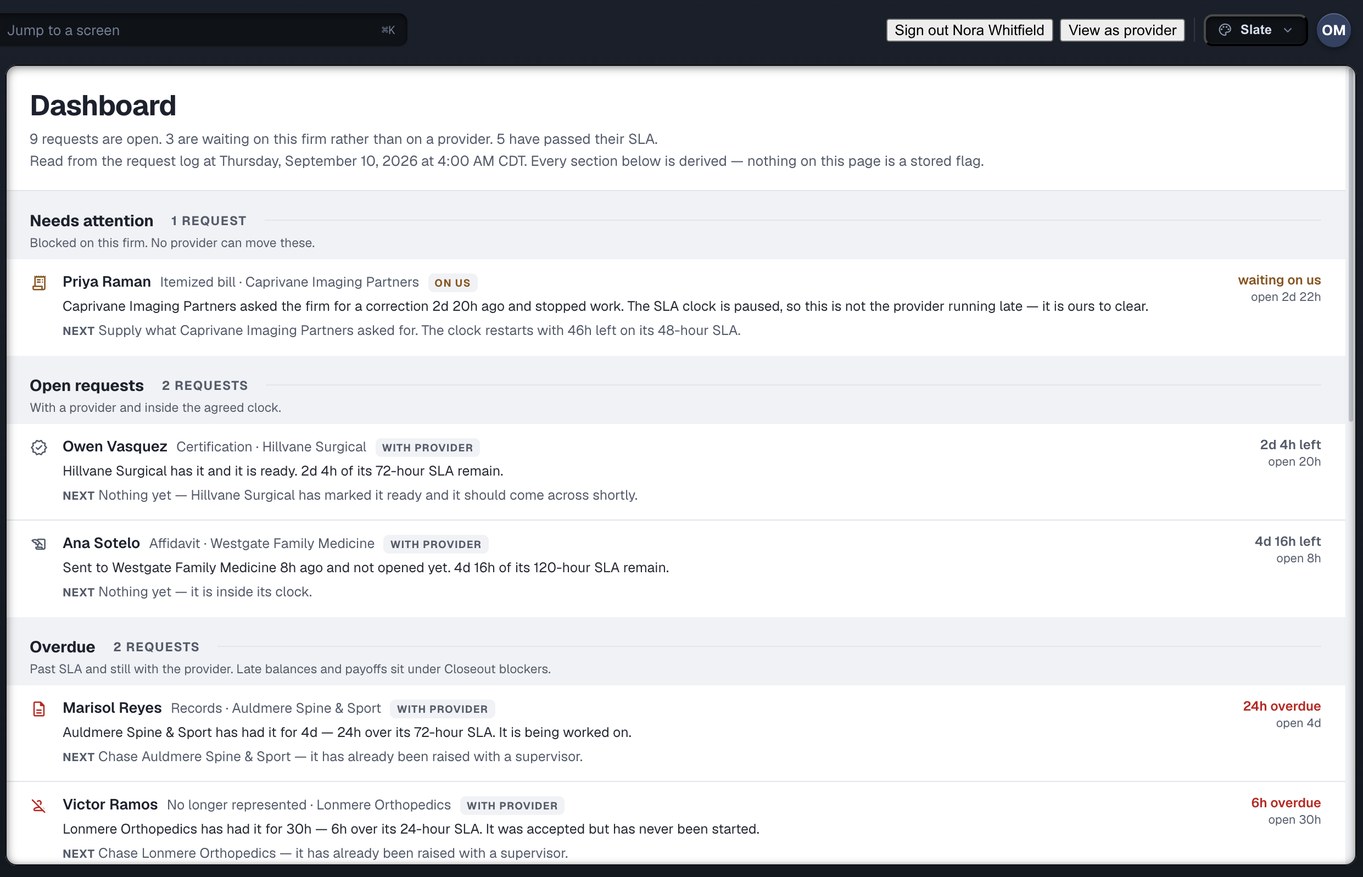
Captured from the running build, 24 September 2026. Demonstration data — every name, matter and figure is a fixture, not a real client, clinic or balance.
The client stopped treating six weeks ago, and the status was accurate the whole time
Three things go wrong on the medical side of a case, and none of them is a slow clinic. Each one is a row that went quiet while everybody believed it was being worked.
The no-show goes grey and drops out of the filter
The systems firms use today name the failures — no-show, unable to reach, cancelled by patient — and then do nothing with them. The row leaves the default view, the client decides they are fine, and the treatment gap is in the defence’s hands before anyone at the firm has rung them.
Three weeks of silence from a clinic that was never going to answer
A directory will show you a clinic. It will not tell you whether a request sent to it will reach a records desk at all, what it will cost, or that a colleague spent a month on the same facility in March. You find that out by sending, then waiting.
You chase the clinic for your own missing signature
The clinic sent the release back for a correction eleven days ago and, correctly, stopped. Nothing on your screen says so, the row still reads as the clinic running late, and the next call to their records office is about a delay that is sitting on your desk.
Five mechanisms, and four of them are screens you will open every morning
Injury Docs is one system the firm and the clinic both open, so a referral, a request and a message are the same object on both screens. That is what lets each of the following be true.
A failure is a state that owes somebody a next move. It is not a label.
Send a client to a clinic and the referral moves through named states: chosen, sent, viewed, accepted, scheduling, a time offered, booked, seen, follow-up. Then the part that matters. Declined, unreachable, no-show and reschedule-needed are open states here, not endings. You cannot reach the end of a referral by failing. The only two exits are closed — a person decided — and cancelled, because the firm withdrew it.
- Every open state names an owner, an action, a due time and a sentence. A no-show is the clinic’s to re-book within a day; a client nobody can reach is yours to ring within a day, because the firm holds the number the client actually answers
- A rescue that has failed twice since the client was last seen is not tried a third time. The referral comes back to the firm for a decision: a different clinic, or close it and put the treatment gap on the matter in writing
- A clinic’s question — “do you have the lumbar MRI?” — pauses their clock and puts the answer on your desk without un-accepting the referral
- A referral turned down by two clinics and accepted by the third is one row with one history, and the same packet travels each time
What this means for you: the rescue queue is the first thing on the screen, not a tab. A missed appointment re-booked the next morning is a gap of days. The same one noticed six weeks later is a gap the defence reads out.
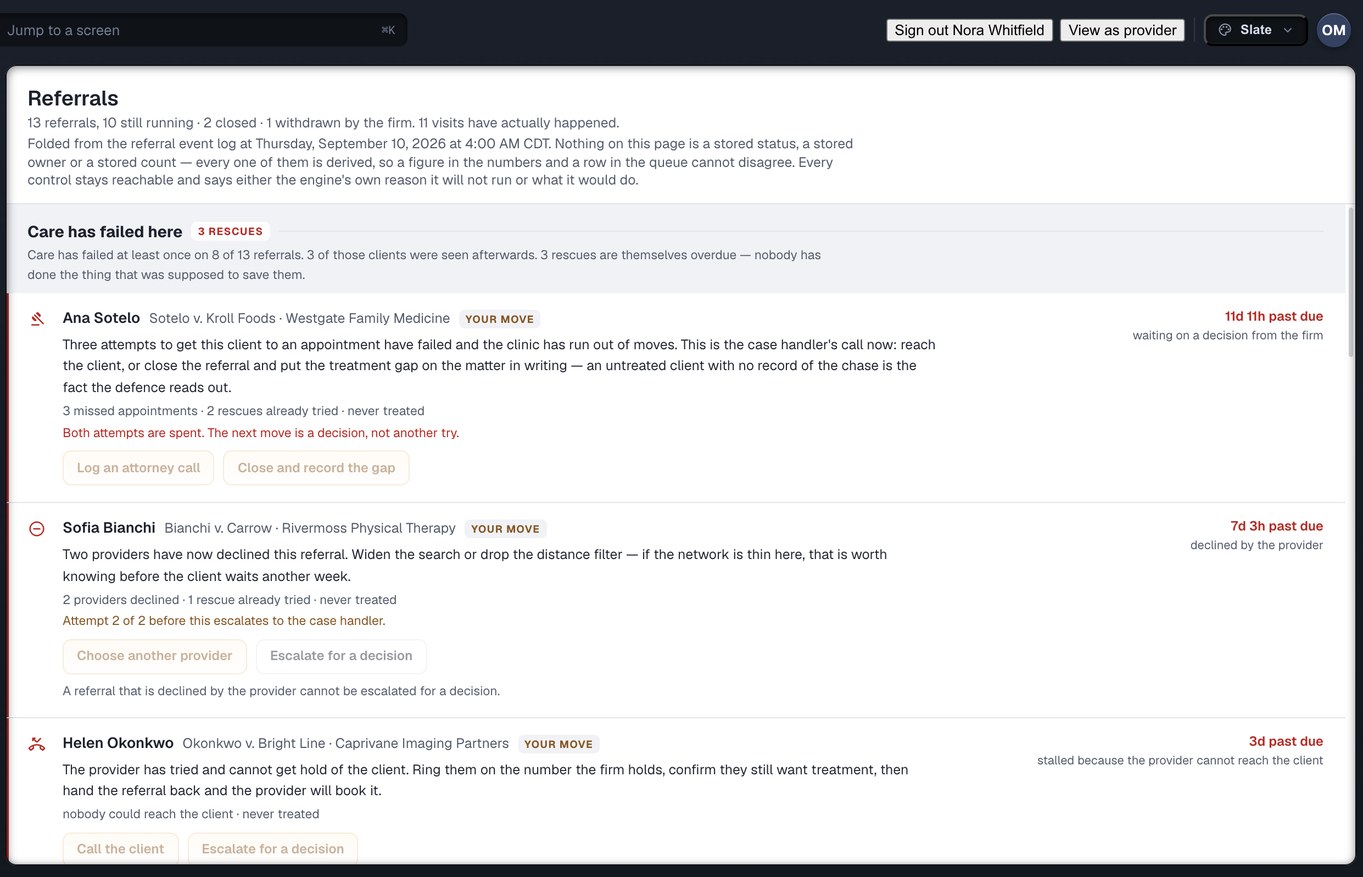
The firm Referrals screen. Captured from the running build, 24 September 2026. Demonstration data — every name, matter and figure is a fixture, not a real client, clinic or balance.
Where did the client treat, can we reach them, and what does it cost — before you order
Discover answers two questions from one screen. Find a provider takes a clinic name off a bill and reads our own provider graph; nothing about a client leaves the building. Find treatment takes a named person and a date range and asks outside sources where they went. That second search is a question about somebody’s medical history, so it is gated: with a release that is unsigned, expired, revoked or too thin to identify the client, the search does not run. Not run-and-hide. Does not run. There is no override, because the only thing that resolves the refusal is a better piece of paper, and the screen says which one.
- Every result is a candidate with a band, never a score beside a clinic’s name. “Confirmed” is reserved for a match an accountable party stands behind — the clinic’s own records desk, or a payer with a claim. Three weak signals agreeing never add up to it
- A signal too weak to name is withheld: counted, attributed to its source, and stripped of the clinic’s identity. A wrong answer here is a disclosure of a treatment relationship that does not exist, and there is no retraction that undoes it
- Four reachability answers, each with a different next action: on the network, reachable through a partner, worked by Omnis on your behalf, or no route we can stand behind
- The cost of a records request to that clinic, priced under the applicable schedule. With no page count yet it is shown as an estimate that names which figure is still unknown — a preview, not a bill. Turnaround appears only where the records desk has stated one
- Known providers and new ones are kept apart. A clinic already on the matter turning up is a completeness check; one nobody on the file knew about is a discovery. They go to different people
What this means for you: the expensive failure is not a slow clinic. It is planning a week around records that were never obtainable. The fourth reachability answer is the one that saves it.
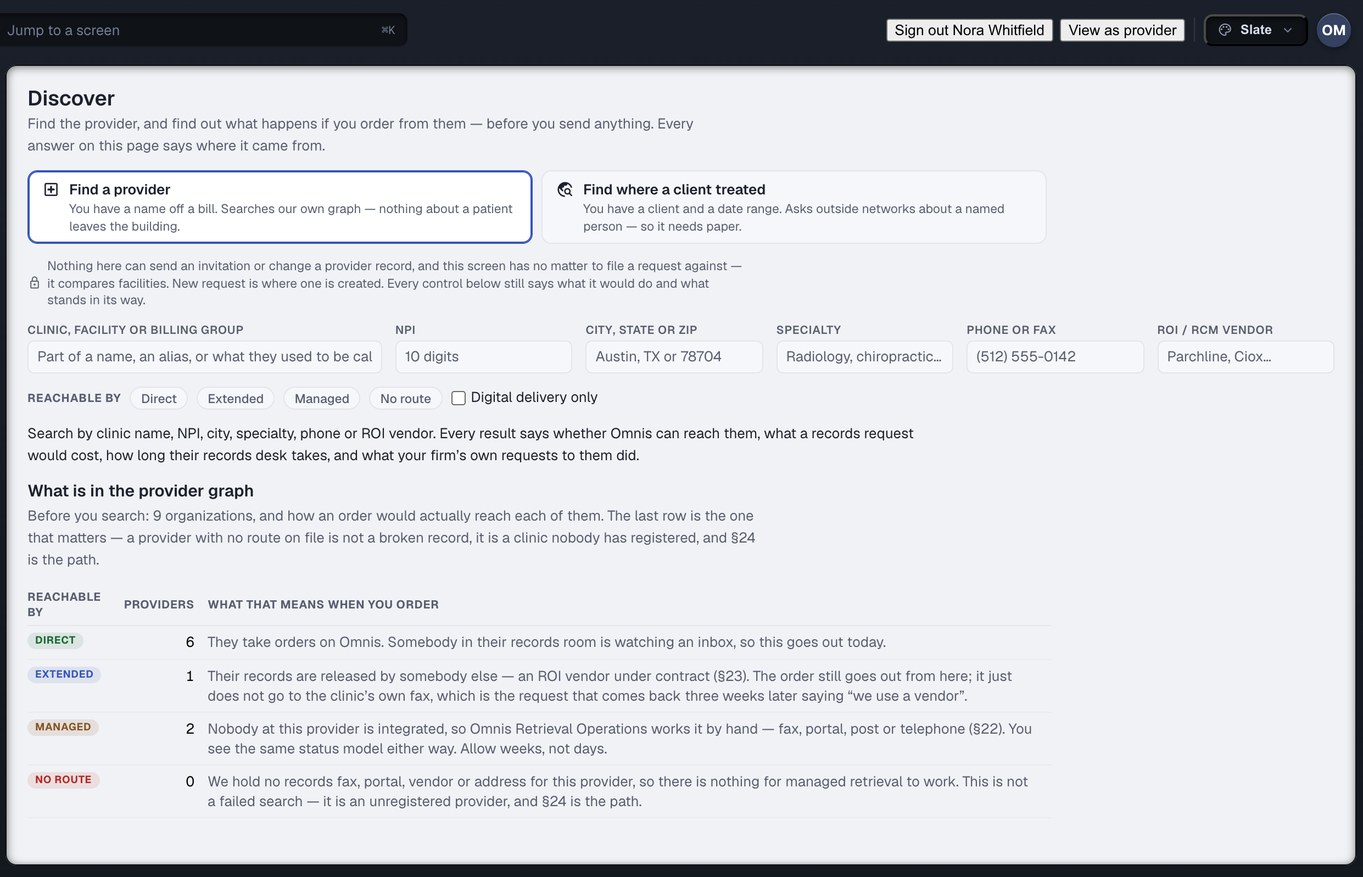
The firm Discover screen. Captured from the running build, 24 September 2026. Demonstration data — every name, matter and figure is a fixture, not a real client, clinic or balance.
The clinic’s clock pauses when the delay is the firm’s. That row is now on your desk.
When a clinic sends a request back for a corrected release, a narrower date range or a second identifier, their clock stops and restarts only when you unblock them. That is fair to the clinic, and it is why they answer this queue before the fax. It also means no “overdue” reading will ever catch that row — so the dashboard claims it first, files it under Needs attention, and attributes it to us. The section’s own one-line description is “Blocked on this firm. No provider can move these.”
Four things put a request there: the clinic asked for a correction and stopped; an open dispute; a request raised and never sent; and documents that arrived and nobody downloaded for three days. Every row carries the sentence that put it there — which clinic asked for what, how long ago — and the action that clears it, with the time the clock restarts with. Not a count. Not a coloured dot.
- Both numbers are on every row: hours the clinic has actually held it, and hours since you raised it. The paused interval is visible, not hidden in a calculation
- A live request sits in exactly one of five work queues — Needs attention, Awaiting approval, Closeout blockers, Overdue, Open — so nothing is counted twice while you clear a morning
- Awaiting approval outranks Overdue on purpose. A request that is both is a cheque waiting on you, not a chase, and ringing the clinic about it is the wrong move
- Two look-backs sit outside the queues: what landed in the last two weeks, and what ended without records — a records request the clinic refused does not quietly leave the page to be rediscovered at demand time
- The clinic’s clock stops the moment they fulfil, not when somebody at the firm gets round to downloading — and the download that has not happened is your row, not theirs
What this means for you: the dashboard is about the firm, not only about what clinics owe the firm. Most portals do not have this section, because it is the one that names the reader.
A thread is attached to the request it is about, and carries the request’s clock
Messages is not an inbox. It is every conversation with a clinic, read against the request each one belongs to. A records clerk works a stack and sends one email — “Whitfield and Hollingsworth are ready, Reyes we have nothing for” — and that is one message about three requests. It is stored once and joined to all three, rather than filed under one while the other two go silent, or copied three times so a later correction misses one.
- One timeline across portal, email, SMS, fax, phone, internal notes and automated notices, in order. The reminder the platform sent at six on Tuesday sits between your two emails, because it is usually why the second one exists
- Conversations are grouped by whose move it is. “Waiting on them” is timed from the first unanswered message, so a reminder sent yesterday does not make a nine-day silence look new. “Waiting on us” is every hour that is ours — and on a paused request, time the clinic is not being charged for
- There is no “read” tick. Delivery and read are claims that name their source — a mail server accepted it, a remote image loaded — so nobody escalates to a supervisor over a message that sat in a spam folder
- A clinic’s canned response is a move on the request, not a piece of copy. “Authorisation invalid” pauses their clock and puts the answer on your desk with the reason recorded. “No records” is deliberately two templates — cannot find this patient, which is recoverable with a second identifier, and nothing for that period, which ends the request
- The expensive case is surfaced on purpose: a clinic has answered in the thread and nobody moved the request, so their clock is still running against them for a question they already answered
What this means for you: “what did we tell them, and what did they tell us” has one answer, in order, on the request — not in whichever mailbox the paralegal on holiday used.
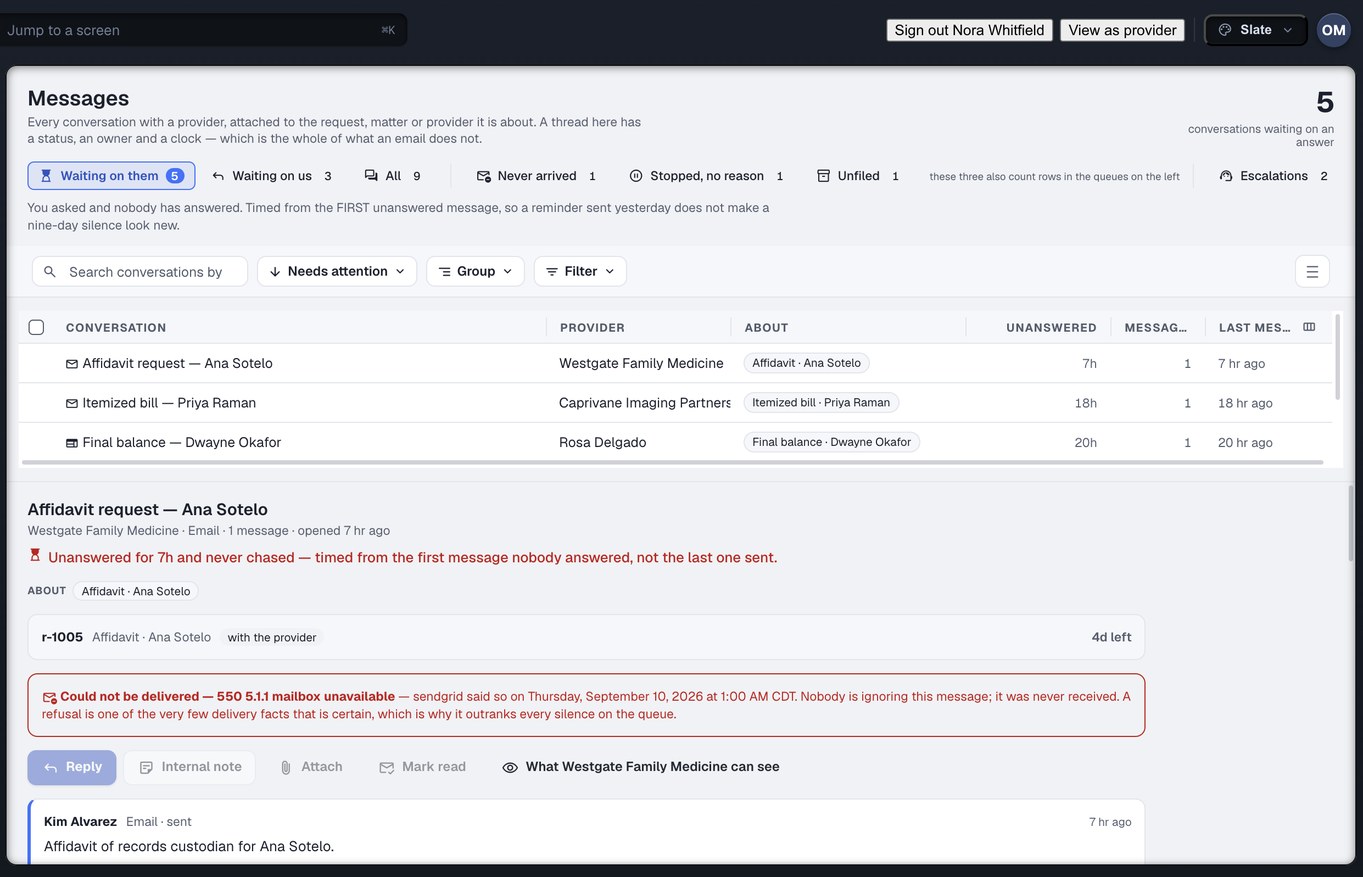
The firm Messages screen. Captured from the running build, 24 September 2026. Demonstration data — every name, matter and figure is a fixture, not a real client, clinic or balance.
Everything that is wrong across your caseload, ranked by what it costs — not by how many rows a clinic generated
Fourteen kinds of exception, from the ones that stop a request being acted on (a bad authorisation, a patient the clinic cannot identify, a practice that changed hands) through the ones that stop it being paid, to the ones wrong with what came back (partial, overdue, wrong patient, wrong dates, missing pages, a disputed invoice). None of them is detected here. Each is projected from the finding another part of the product already raised, carrying that engine’s own severity and its own remedy sentence word for word, so the queue can never disagree with the ledger or the authorisation vault about one defect.
- Sorted by consequence. One exception with a large balance behind it goes above four small ones from a noisier clinic, because the queue exists to say what the morning is for
- A blocking exception is never ranked below a warning. “Critical” is reserved for a consequence that has already happened — money that left the trust account, records released on revoked paper
- Every row names whose desk it is on — the clinic, Omnis retrieval, a partner, your records desk, your billing desk, an attorney, the client — and merges only within one desk. A request that is late because its release is defective is one row about the release, not two instructions
- Every row names how it is meant to end, from a closed list of seventeen resolution codes in four families. Twelve invalid-authorisation exceptions at one clinic all closing as “corrected and resubmitted” says your release template does not satisfy that facility: one change to the request builder, not fourteen phone calls
- The counts reconcile on the page: findings received, carried on rows, merged, and the ones it could not classify — shown and labelled, never dropped
What this means for you: “what is wrong across my whole book, and whose desk is it on” has an answer. Read the Exception Center page →
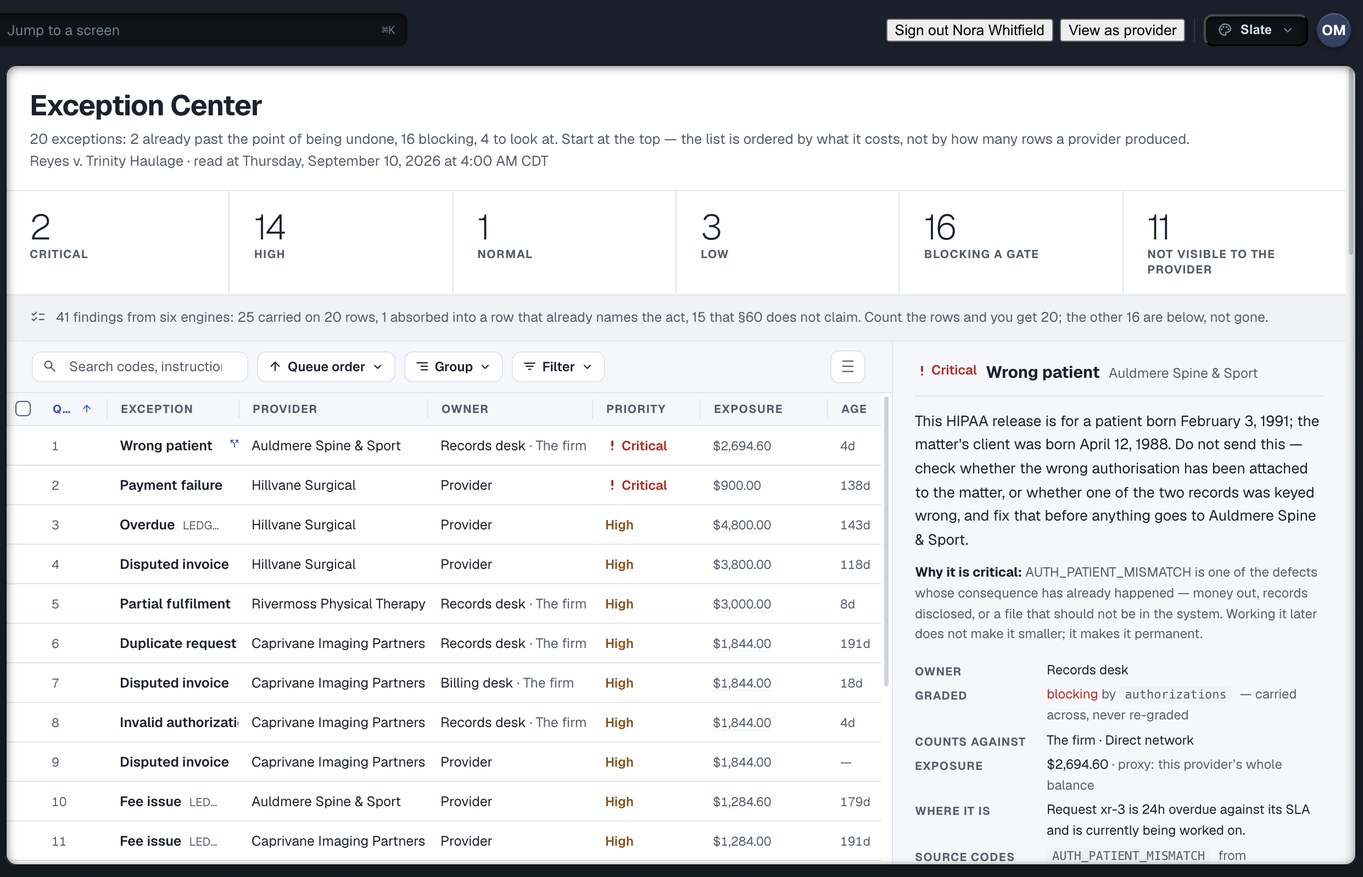
The firm Exception Center. Captured from the running build, 24 September 2026. Demonstration data — every name, matter and figure is a fixture, not a real client, clinic or balance.
Counted from the build, not from a case study
Facts about what exists, counted on 24 September 2026. We have no customer outcome figures, and we would rather print none than print a guess.
The firm rail has fourteen destinations. These are the ones you will live in.
One renderer, one component set. The clinic opens the same exchange from their side, so a referral, a request or a thread is one object with one state and one clock on both screens.
The four that are about the treatment picture
Referrals
Send a client to a clinic and track the appointment through to seen. The rescue queue is the top of the screen.
Discover
Find a clinic, or find where a client treated — and what it costs to order, before you send.
Messages
Every thread with a clinic, against the request it belongs to and that request’s clock.
Exception Center
Everything that is wrong, whose desk it is on, and what would end it.
And the rest of the firm’s desk, which you will open when a case needs it
Dashboard
What needs attention, what is open, what is overdue, what is awaiting a fee approval, what blocks a closeout, what just landed and what ended without records. Every sentence derived from the request log.
New request & Requests
Raise any of the thirteen asks against a clinic with the materials itemised rather than described, then watch every one of them through twenty-one states. Records requests →
Providers
Who treats on a lien, and your firm’s own preferred network. The public directory →
Bills & Balances, Liens, Closeout
One ledger per matter, read by the clinic too; the reduction ladder with every offer and its stated basis; and what still blocks disbursement. Bills → Liens →
Experts & Reports
An engagement that cannot be constructed without a conflict clearance attached; spend, fulfilment time, overdue rate and provider performance, each figure with its denominator.
Settings
The firm, its people and their roles — case manager and medical coordinator among eleven firm roles — and how the app connects to the case system.
A gap becomes a records request. It does not become a paragraph.
Injury Docs measures the holes between visits from the records and bills on the matter, and it treats each hole as a claim that might be wrong. Three ordinary things make a gap unprovable, and each one is turned into a piece of work with a remedy on it rather than a caveat nobody can act on.
- A records request covering the window is still open. The gap is qualified by that request, and the sentence on it says: this may not be a treatment gap at all — chase it before anyone explains a hole that might be full of treatment
- Pages in the file have no date on them. The remedy is a call to that clinic’s custodian for the encounter list, which closes this gap and every other one the same page is qualifying
- A visit inside the window has an inferred date — “ten days post-op” counted forward from an operative report. The gap is reported at its full length and the inference is named, so you can go and get the dated record before it goes in a demand
- A hole in one clinic’s chart is not a hole in treatment. Twelve weeks of chiropractic followed by eight of PT is continuous care with a missing discharge note, and the two are kept in separate lists
Three things this deliberately is not
Not the medical narrative
Injury Docs finds the gaps and turns them into requests. Writing the timeline of care out of the records — the summary an attorney reads before a demand — is MedChron, a different Omnis product. Gap detection here feeds requests; it does not author the narrative.
Not your case system
It is the exchange between your firm and the clinics, and Settings is where it connects to the case system you already run matters in. Nothing here is a matter file, an intake or a settlement calculator.
Not something the client opens
There is nothing for an injured person to sign into, and nothing planned. The referral’s owner is always a person at the firm or the clinic, never the client, because you cannot assign a task to somebody in software they have never opened. What we tell injured people →
The six that come up first
What actually happens when a client no-shows?
The referral moves to an open state called no-show, and the clinic owns re-booking it within a day — the day after a missed appointment is when a client can still be talked back in. If the clinic cannot reach them, the referral comes to you, because the firm holds the number the client answers. Two failed rescues since the last visit and it stops being an attempt and becomes a decision: another clinic, or close it with the gap recorded on the matter in writing.
Why did Discover refuse to search for my client?
Because a treatment search sends a named person’s details to outside sources and asks about their medical history, and the paper on file does not license that. The refusal says which defect — unsigned, expired, revoked, thin identifiers, a scope that does not reach — and what would fix it. There is no override, because the only real fix is a better release. Finding a clinic by name is never gated; nothing about the client leaves the building for that.
A row says “waiting on us”. What do I do with it?
Read the sentence on it. It names the clinic, what they asked for and how long ago, and the action says what to supply and how much time the clock restarts with. While it sits there the clinic is not being charged for the delay, which is fair to them and is exactly why it is the first section on your dashboard rather than a badge.
The clinic says they have nothing under that name. Is the request dead?
No. “We cannot find this patient” is recoverable, and the product keeps it apart from “nothing responsive for that period”, which is final. The first pauses the clinic’s clock and puts a second identifier on your desk — a client who treated under a maiden name is the ordinary case. If the clinic said it in the thread and nobody moved the request, Messages shows that too, because their clock is still running on a question they already answered.
Does the Exception Center replace the dashboard?
They answer different questions. The dashboard is about requests: which are open, overdue, waiting on you, or blocking a closeout. The Exception Center is about defects across everything — authorisations, bills, files, payments, closeouts and requests — ranked by what each one costs and merged where several findings mean one phone call. Most mornings start with the dashboard; the Exception Center is where you go when something is wrong and you need to know whose desk it is on.
Will it write the medical summary for the demand?
No. It measures the holes between visits from what is on the matter and turns each one into a piece of work — a request to chase, a custodian to ring for an encounter list, a dated record to go and get. The narrative an attorney reads is MedChron, a separate Omnis product, and we keep the two apart so neither has to pretend to be the other.
Bring the referral that went quiet in March.
Create your firm account and put one caseload’s referrals, requests and threads through the queue, the clock and the Exception Center — and see which rows were sitting on your desk the whole time.
Run a clinic? Read the provider side → · The whole firm desk? Injury Docs for law firms →