Everything that is wrong, in one ranked list.
Not a list of alerts, and not sorted by age. Every finding from every engine arrives here ranked by what it costs you and what it blocks — duplicates merged into one row, every row naming whose desk it is on, and the counts reconciling out loud so you can check the page by hand.
Sorted by what it costs and what it blocks — never by age
An alert list sorted by age puts a two-week-old status query above the missing payoff that is holding a disbursement. The ranking here is computed from what a problem is costing and what it is standing in the way of, so the top of the list is the work that most deserves the next hour.
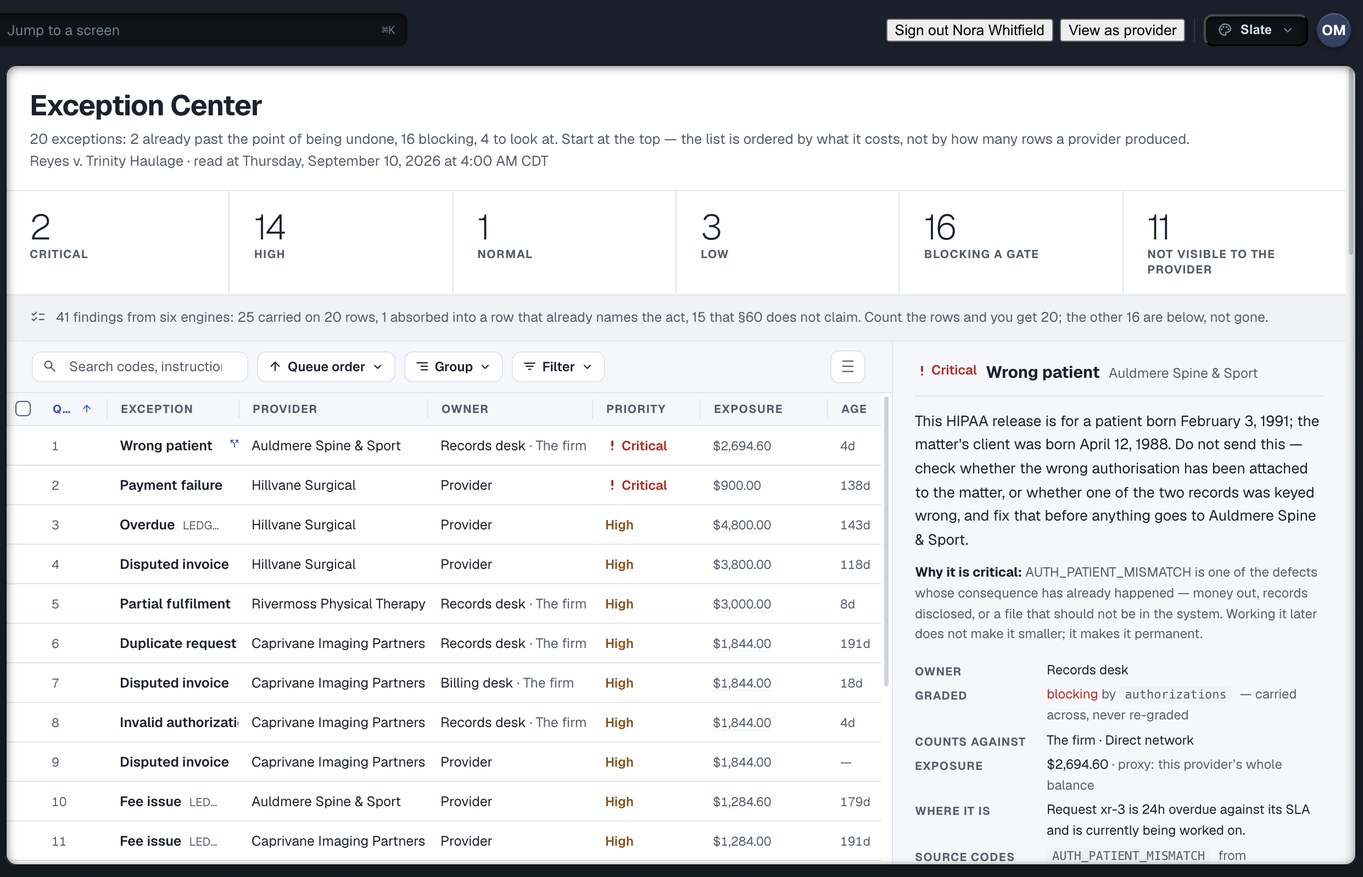
Captured from the running build, 24 September 2026. Demonstration data — every name, matter and figure is a fixture, not a real client, clinic or balance.
Cost, then blast radius
A finding that holds up a disbursement outranks one that holds up nothing, however old the second one is. The ranking is a rule you could check by hand, not a score nobody can explain.
Across the whole book
Not per matter, and not per clinic. One list for the firm, so the question “what is wrong across everything we are running” has one place to be answered.
The question nobody else answers
The systems firms use today will show you a queue per screen. None of them answers what is wrong across your whole book and whose desk each piece of it is on. This is the answer to that question.
A late request that is also missing its bill is one row
Three engines can notice the same broken thing and file three findings about it. Left alone that is how a queue of forty real problems presents as a hundred and twenty, which is how people stop reading it. Duplicates are collapsed into a single row that carries both facts — neither of them lost in the merge.
Three rows in an ordinary alert list. The same paralegal picks up the same clinic three times and closes two of them as “already chasing”.
One row, three facts, one phone call. Nothing was discarded to get here — the merge is counted and reported, as below.
Every row names an owner and an exit
A finding with no owner is a complaint. Every row here says which of three desks it is sitting on, and states the single thing that would take it off the list — so a queue review is a set of assignments rather than a discussion.
- Your desk. A corrected authorisation, an answer to a clinic’s question, a decision on a counter.
- The clinic’s desk. A chart, an itemised statement, a payoff figure, an answer on a reduction.
- Our desk. Where the Omnis retrieval desk is working an off-network clinic on your behalf.
And because a clinic’s clock pauses while they are waiting on you, a row sitting on your desk never quietly counts against them.
How the clock decides whose delay it is →What it could not classify is shown, never dropped
This is the part we are proudest of. A queue that silently discards what it does not understand looks tidier and is worth less, because the thing it dropped is exactly the thing nobody else was going to catch. The header states how many findings it received, how many it carried, how many it merged and how many it could not classify — and the arithmetic is on the page, so you can check it by hand.
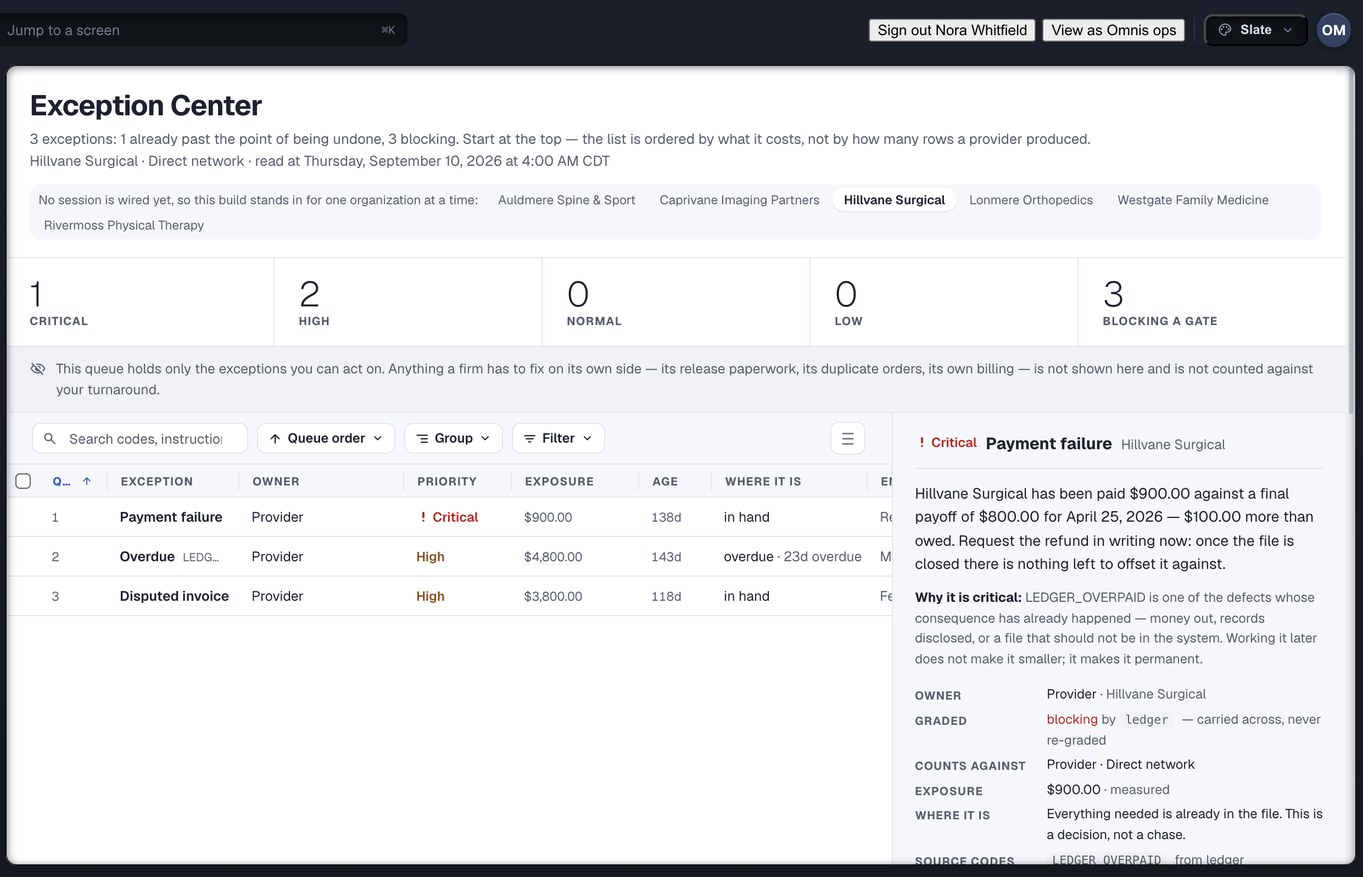
The same queue from the clinic’s chair, with its own header. Captured from the running build, 24 September 2026. Demonstration data — every name, matter and figure is a fixture, not a real client, clinic or balance.
The number on the page is checkable
Carried, merged and unclassified add up to received. If they ever did not, the page would be telling you something was lost — which is the entire reason the counts are printed.
Unclassified is a state, not a bin
A finding the rules do not recognise stays visible and stays labelled. Nothing is forced into the nearest category to keep the list looking clean.
Merges are reported, not hidden
The count of what was collapsed is part of the header, and each merged row still carries every fact that went into it. A merge reduces reading, never information.
Computed, not inferred
Every ranking and every count here comes from a rule you could reproduce with the log in front of you. For this work, a number you can check beats a number you have to trust.
Thirty-four engines, one queue
Late requests
The SLA engine raises a finding against hours actually held, so a clinic waiting on your office is never the one flagged.
Missing bills
A chart that arrived without the itemised statement it was raised with, and a final bill that never followed a final balance.
Authorisation defects
A separately-protected category asked for without the authorisation that covers it raises a finding the moment it happens.
Ledger disagreements
Where what a clinic’s statement says and what the derived ledger says do not line up, to the cent.
Thirty-four domain engines sit behind the screens — pricing, SLA, lien, ledger and exception rules, with 4,991 automated tests passing as of 24 September 2026. Every one of them files into this single queue rather than into a notification of its own.
What the findings are about
Medical Records Requests
The object a late-request or authorisation finding is raised against — itemised, gated and derived.
Read the requests page → BBBills, Balances & Payoffs
The ledger a disagreement is measured against, and the closeout list a blocked payoff holds up.
Read the ledger page → LRLien Resolution & Reductions
Where an unanswered reduction lives, with every offer, counter and acceptance kept against it.
Read the lien page →One list. Ranked by cost. Every row with a desk on it.
Create your firm account and see what is wrong across your whole book — merged, owned, exit stated, and counted out loud so the page can be checked by hand.
Already have a portal account? Sign in →