Ask for the reduction. Keep the reason you gave.
Liens asserted against the recovery, and every reduction your firm has asked for — each offer, counter and acceptance kept, with the basis you stated recorded beside it. The clinic reads that basis word for word, on the same ledger you read.
The claim on the recovery, next to the bill it came from
A lien asserted by a clinic is a claim against money your client has not received yet, and it is usually tracked somewhere other than the bill it grew out of. Here it sits on the same matter, next to the same charges, computed from the same log — so the figure being asserted and the figure you hold can be compared without a phone call.
Asserted, not assumed
The lien record holds what the clinic actually asserted and when, rather than a figure a paralegal copied off a letter into a spreadsheet six weeks ago.
Attached to the charges
The itemised bill, the billing ledger and the balance behind the lien are asks on the same state machine. You can open the document the number came out of.
One list per matter
Every clinic asserting against the recovery in one place, with what is outstanding to each. That list is what closeout asks its question of when the case settles.
A boundary, stated plainly. Injury Docs does not advance money to an injured person, offer them anything against their case, or put a financial product in front of them. It moves records and reconciles the bills attached to them. There is no account for an injured person here, and none planned.
Every offer, counter and acceptance is kept
A reduction is a conversation with rungs, and most firms keep it in a call note. Here each rung is a fact on the record: who moved, to what figure, on what date, and on what basis. Nothing is overwritten when the next rung lands, so a correction never erases what it corrected.
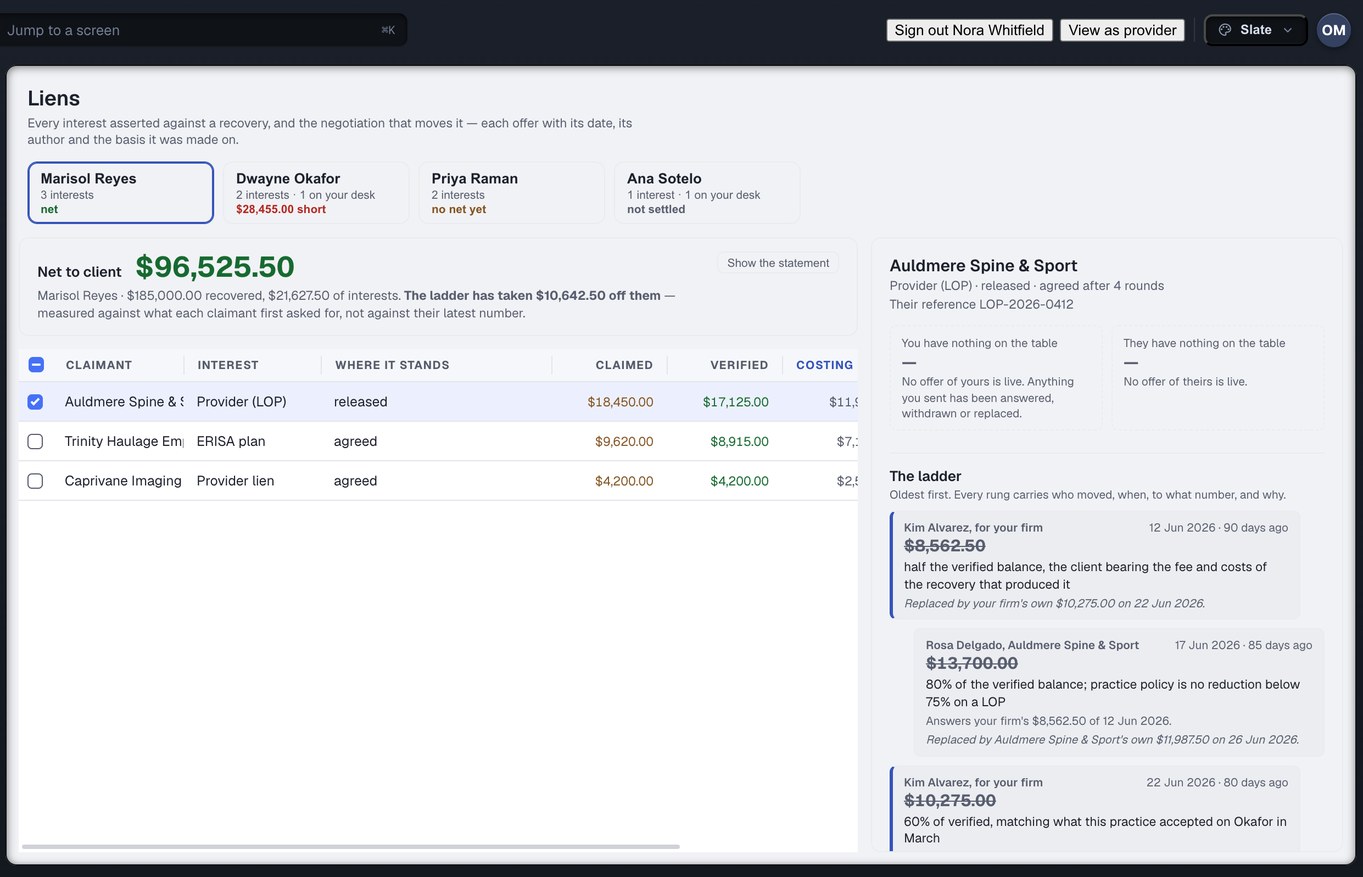
Captured from the running build, 24 September 2026. Demonstration data — every name, matter and figure is a fixture, not a real client, clinic or balance.
The ladder survives the file review
Six months on, the question is not what was agreed — it is what was asked, what was refused, and why. All of it is on the record, in order, with dates.
An ask, like every other ask
A reduction request rides the same state machine as a records request: a state derived from the log, an owner, and a clock that pauses when the delay is yours rather than the clinic’s.
No rung goes missing
The history is append-only. A figure superseded by the next counter is still readable, which is how you tell a settled negotiation from one that quietly stalled.
Exact to the cent, every rung
Every figure in a negotiation is rendered to two decimals. Nothing here is rounded, so what came off the lien matches what the clinic’s own statement says came off.
The clinic reads your reason word for word
Most reduction asks arrive at a clinic as a number with no argument attached, and get answered the same way. Here the reason you gave is part of the record and is rendered on their screen verbatim — not summarised, not paraphrased by a system in the middle.
- Where your screen records a reconciliation, the clinic sees the amount removed and the reason for it.
- The basis is stored with the rung it belongs to, so a later reader can tell which argument moved which figure.
- Nothing is written on your behalf. The words on their screen are the words you typed.
- The clinic answers on the same object, so their reply lands on the negotiation rather than in a mailbox.
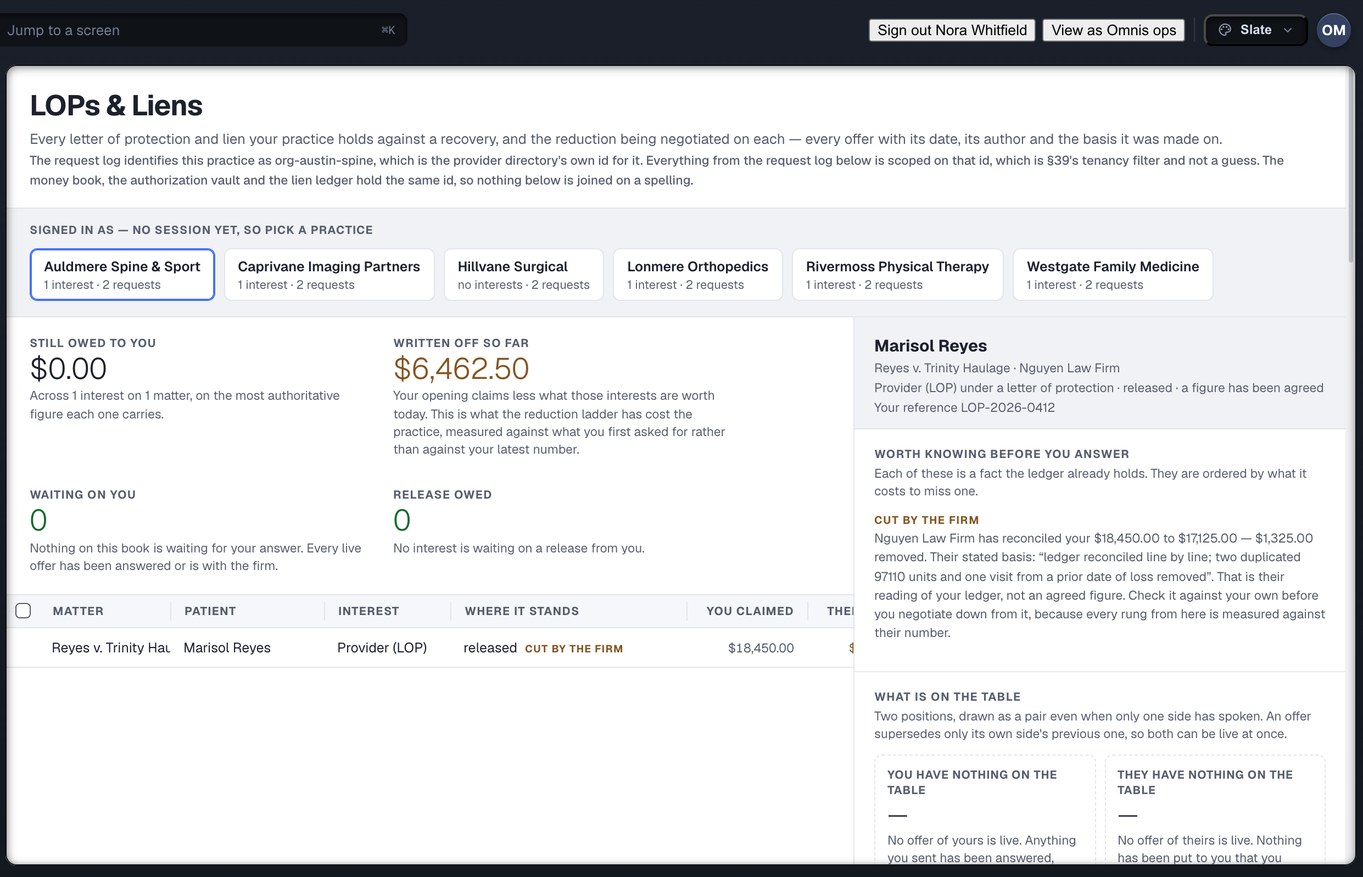
The same ladder, from the clinic’s chair. Captured from the running build, 24 September 2026. Demonstration data — every name, matter and figure is a fixture, not a real client, clinic or balance.
Accepted on Tuesday, on the ledger on Tuesday
The reduced column
What came off appears as reduced on the matter ledger, and outstanding is recomputed on read. There is no second step where somebody updates a balance.
Closeout notices
An unanswered reduction is one of the things that blocks disbursement, and closeout names it as a blocker with a desk rather than as a silence.
The release follows
Final balance, payoff and release are asks on the same machine. The clinic signing off on the reduced figure is a state change you can see, not a letter you hope arrived.
A stalled ask is a finding
A reduction nobody answered arrives in the Exception Center ranked by what it costs and what it blocks, on one row with anything else wrong with that clinic.
Two systems that sync can disagree, and the one people trust is usually the one that is wrong. Two views of one record cannot.
Why the clinic is not sent a copy of your negotiation. From the Injury Docs design notes, 11 September 2026.
What a lien sits on top of
Bills, Balances & Payoffs
The ledger a reduction lands on — billed, paid, adjusted, reduced and outstanding, and closeout at the end of it.
Read the ledger page → RRMedical Records Requests
The itemised bill and billing ledger a lien argument is built on, raised from one builder with the materials named.
Read the requests page → ECThe Exception Center
Where an unanswered reduction goes — ranked by cost and by what it blocks, with the desk it is on named.
Read the exceptions page →Run the reduction on the record, not in a call note.
Create your firm account and keep every offer, counter and acceptance — with the basis you stated attached to it, and readable by the clinic word for word.
Are you a clinic? Read the provider side →