One ledger. Both sides read the same derivation.
Billed, paid, adjusted, reduced and outstanding — per matter and per provider. Not a balance somebody stored and forgot to update, but a figure folded on read from the same request log every screen uses. Exact to the cent, with no rounding anywhere.
Five numbers, and where each one comes from
A matter’s money lives in three places today — the bill, the lien and the payoff — which arrive at three times and are reconciled by hand while the demand is being drafted. Here they are one ledger, per matter and per provider, and every line on it traces back to a request you can open.
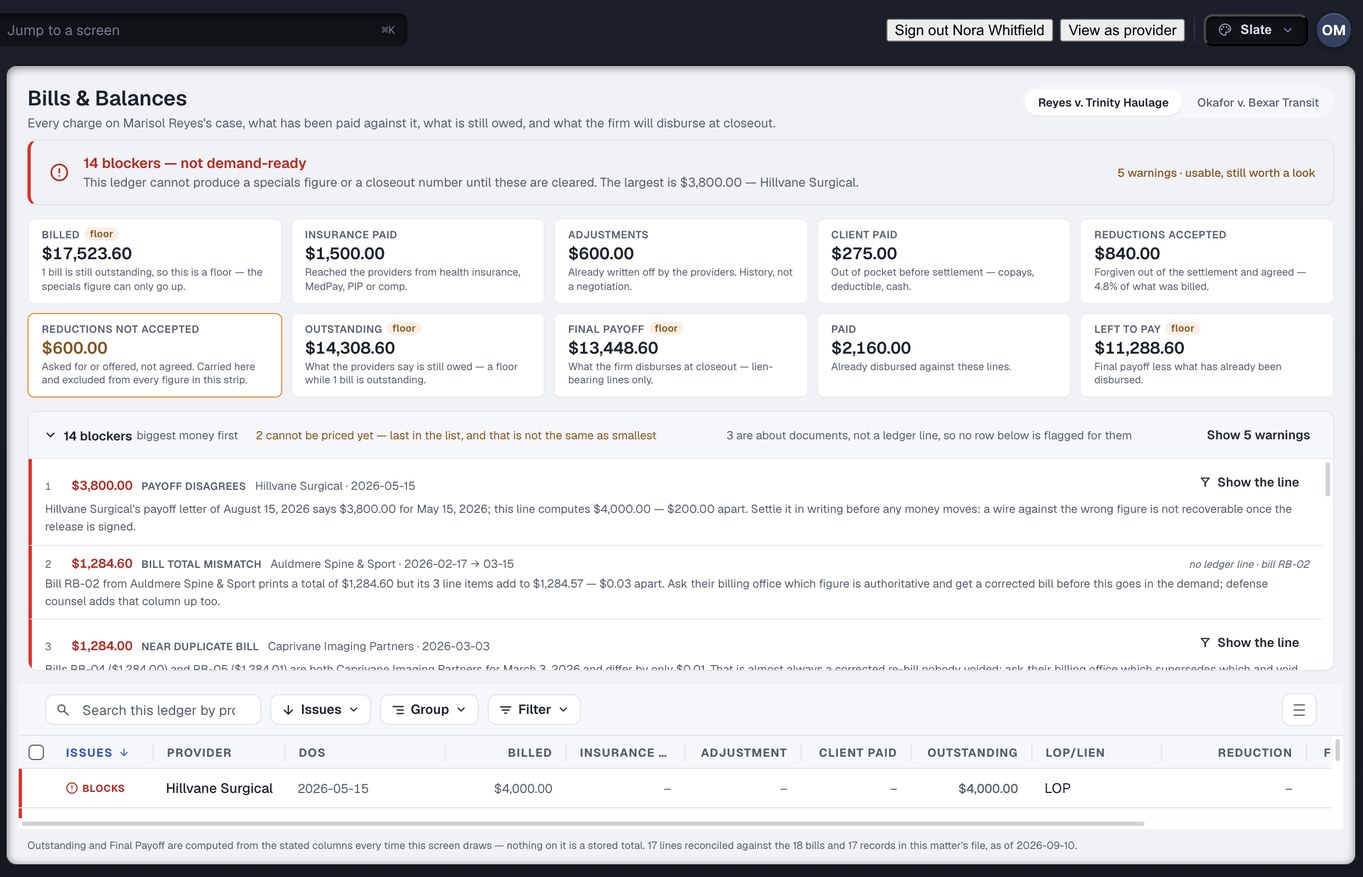
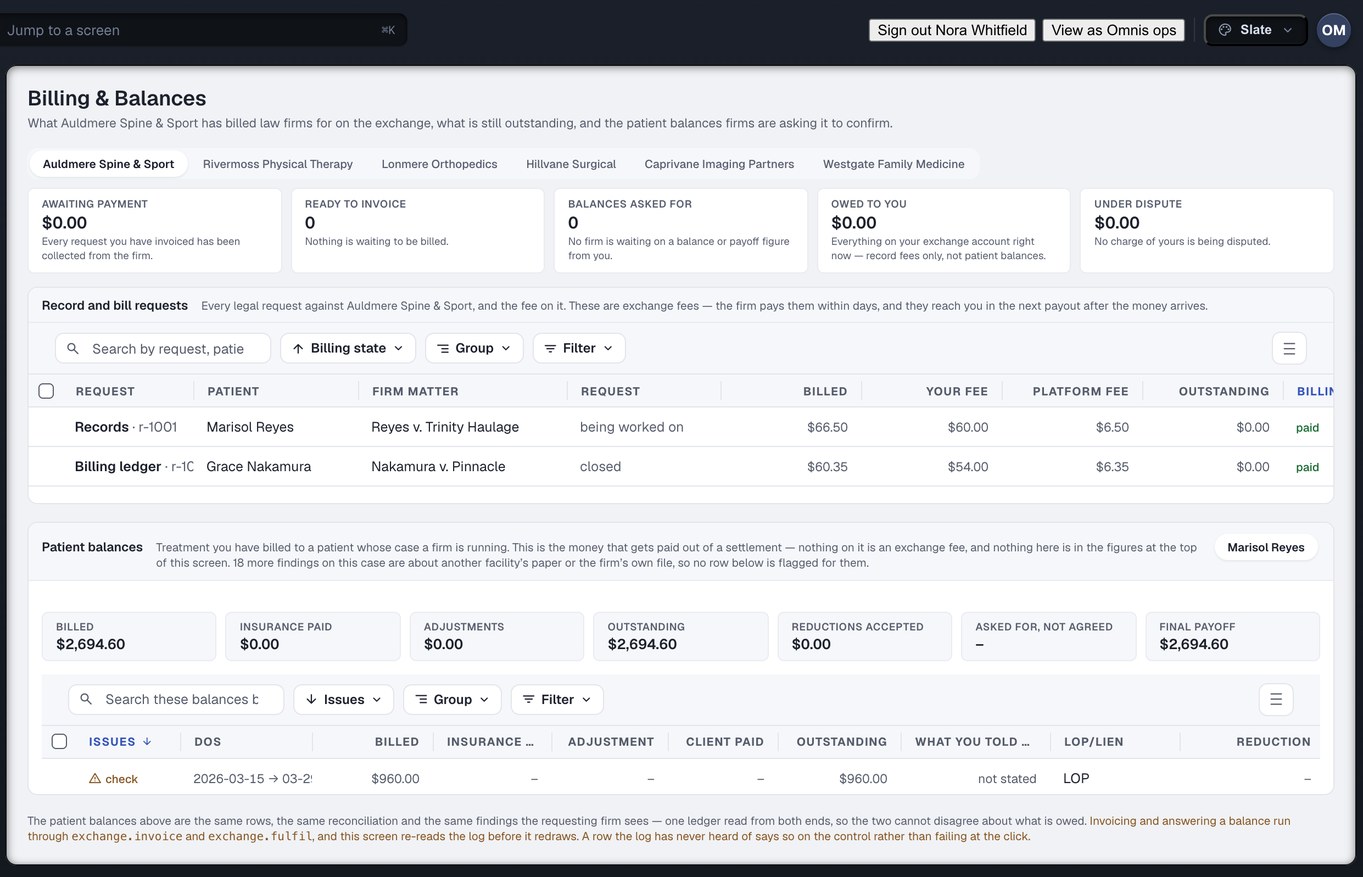
Captured from the running build, 24 September 2026. Demonstration data — every name, matter and figure is a fixture, not a real client, clinic or balance.
There is no balance column anywhere in this product
Every figure on this page is folded on read from an append-only log of what actually happened — requested, returned, queried, corrected, part-paid. A stored balance plus a separate audit trail gives you two records that can come apart, and the one people trust is usually the one that is wrong.
It comes from the request log
The itemised bill, the billing ledger, the balance and the payoff are all asks on the same state machine as a records request. The ledger is what those answers add up to, not a second system.
A correction never erases
Nothing in the history is overwritten. When a clinic corrects a charge, the correction is a new fact on the record and the old one is still there — which is what you need nine months later.
Your screen and theirs
The firm and the clinic are two navigations over one transaction. Where your screen records a reconciliation, the clinic sees the amount removed and the reason you gave for it.
When a balance is disputed nine months later, the question is what happened — and the answer should be on the record rather than in somebody’s recollection.
Why every financial figure here is derived. From the Injury Docs design notes, 11 September 2026.
No rounding anywhere in the product
Every figure is rendered to two decimals, on every screen, in every report and in every export. Rounding is where a ledger stops matching the statement it came from, and where a clinic stops believing the number on your side.
- Per matter, and per provider within the matter.
- The bulk order totals the same way — the whole batch to the cent before you commit to it.
- Reports are computed from the same log the ledger reads, so a report and a matter page cannot disagree.
- If a figure anywhere is rounded for display, the caption says that it is rounded.
The afternoon the case settles
A settlement is one event in your system. What it starts is a set of simultaneous conversations with different clinics, each owing a final bill, a final balance, a payoff figure and a statement of what they need before they will sign a release. Your disbursement does not wait on the slowest of them. It waits on the last one anybody remembered to chase.
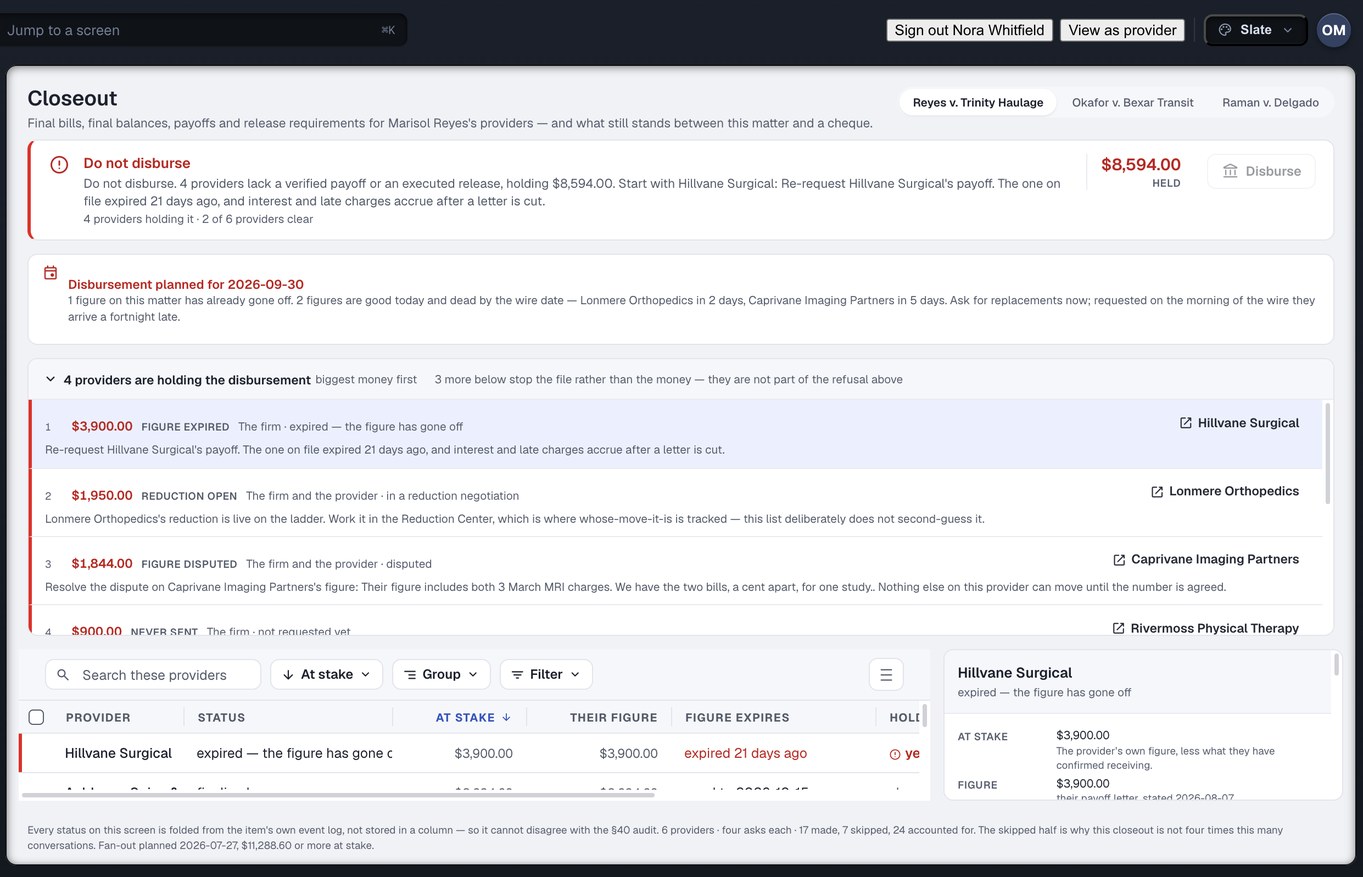
Captured from the running build, 24 September 2026. Demonstration data — every name, matter and figure is a fixture, not a real client, clinic or balance.
One row per clinic, each with its own clock
Final bill, final balance, payoff and release — four things owed by each clinic, tracked separately rather than as one vague “waiting on the provider”.
It re-derives nothing
What is outstanding comes from the ledger, the negotiation from the lien ladder, the ask from the request. Closeout is a question asked of those, not a fourth copy of them.
Every blocker names what would clear it
And whose desk that is on — yours, the clinic’s, or ours. Nothing is marked clear that is not, so the list can be trusted when it says the matter can disburse.
The six-week matter
The matter that sat after it settled did not have a slow provider. It had one nobody was assigned to.
The same ledger, read from four places
Bills & Balances
Every clinic’s billed, paid, adjusted and outstanding amount on one screen — per matter and per provider, derived from the request log rather than a stored balance.
Reports
Spend, fulfilment time, overdue rate and provider performance, computed from the same log every screen reads. Reports about your firm, not only about your vendors.
The Exception Center
A ledger that disagrees with the statement behind it is a finding, ranked against everything else that is wrong — not a discrepancy somebody notices during the demand.
The clinic’s billing screen
The provider side reads the same derivation from their own rail. When you reconcile, they see the amount removed and your stated reason — which is why the conversation is shorter.
Where these numbers come from, and where they go
Medical Records Requests
The asks this ledger is folded from — itemised bills, billing ledgers, balances, final balances and payoffs.
Read the requests page → LRLien Resolution & Reductions
Where the reduced column comes from: every offer, counter and acceptance, with the basis you stated.
Read the lien page → ECThe Exception Center
Missing bills and ledger disagreements, ranked with everything else that is wrong across your book.
Read the exceptions page →Stop reconciling three documents at the worst possible moment.
Create your firm account and put the bill, the balance and the payoff on one ledger — exact to the cent, and read by the clinic at the same time you read it.
Already have a portal account? Sign in →