Retained on the record. Never rated on it.
When a law firm engages you through Injury Docs, the conflict check is completed before the engagement can exist. What you are sent reaches you as a grant with your name and an expiry on it, not as an attachment. Your fee terms and your invoices are recorded as agreed and as billed. And nothing on your profile is a star, a win rate or an exclusion rate — the product refuses to compute them, and this page says why.
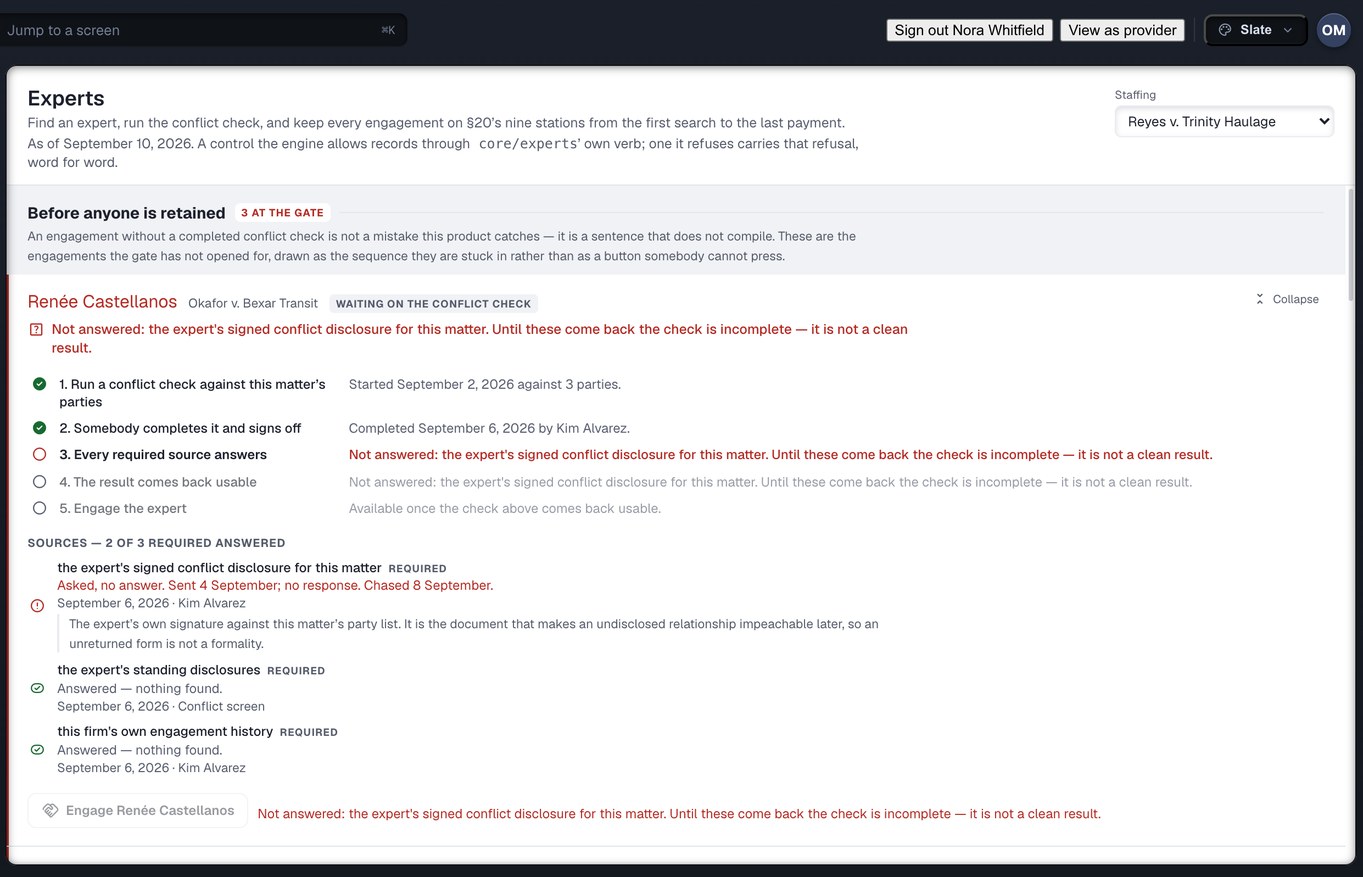
The law firm’s Experts screen, holding an engagement at the conflict gate because the expert’s own signed disclosure has not come back. In this build there is no separate expert-side screen; this is the firm’s view of the one record. Captured from the running build, 24 September 2026. Demonstration data — every name, matter and figure is a fixture, not a real client, clinic or balance.
Three things that go wrong for the expert, and none of them is about the science
A firm rings, a file arrives, a report goes out, an invoice follows. Each of those four is an exchange the systems firms use today keep in an inbox, which is why the same three problems land on your desk, with your name on them.
The conflict surfaces after you have read the file
You examined this plaintiff for a carrier two years ago and wrote that the findings were degenerative. Nobody screened for it, because an examination is not an engagement any firm’s history would show. Now the designation deadline is a week away, you are disqualified, and the firm’s theory of the case is in your head.
The chart arrives as an attachment, and half of it is missing
A zip of PDFs forwarded from a paralegal’s inbox, with no transmittal, no page count and no way to know that the operative report and the imaging are still sitting at the clinic. You write on what you have. On cross, the question is why your opinion did not consider the films.
The invoice argument in month four
“All work at $625 an hour” was agreed by phone; the day rate for trial never was. The firm’s system recomputes your total to its own arithmetic, nobody can say whether the retainer was applied, and the conversation happens against a bill you sent in March to a paralegal who has since left.
An engagement, station by station, from your side of it
Injury Docs is the exchange between personal-injury firms and the providers who treat their clients. An expert engagement runs on the same desk, as the same kind of object: an append-only record of what happened, with a state derived from it rather than typed into it. Everything below is a fact of that record.
Before you are retained
The check is started, completed and answered before you are engaged
A conflict check is three recorded acts: it is started against the matter’s named parties, somebody completes it and signs off, and every required source answers. Three sources are required for every expert — your signed disclosure for this matter, the standing disclosures on your profile, and the firm’s own history of engaging you — and a fourth for medical experts: the record of examinations you have performed, because the worst conflict there is was never an engagement any firm could see.
- The check answers one of five ways: clear, waived, conflicted, unknown, or incomplete. Only the first two open the gate
- Silence is not clearance. Your unreturned disclosure form is “unknown”, and the screen says, in its own words, “Until these come back the check is incomplete — it is not a clean result”
- An engagement cannot advance past a check that was never cleared. The refusal is a sentence: “This expert cannot be engaged yet: the engagement is waiting on the conflict check”
What this means for you: you are never retained on a check that was never finished, and when a firm later says it looked, the record shows what it looked at and when.
Your standing disclosures are read first, and a conflict found later is written down, not erased
What is permanently true of you — a salaried post with a carrier, a retainer with a national insurer, a policy of not taking plaintiff work — is held on your profile in your own words and read before anything case-specific. It is not a conflict by itself; it becomes one against a particular matter’s parties, and the product screens it there rather than pre-judging it on your profile.
- Twelve kinds of finding. Six are disqualifying and cannot be waived by anybody, including the client; six are waivable, and only by a written waiver naming that specific finding — there is no blanket consent
- A clearance is only good for the parties it was run against. A defendant joined in September suspends a live engagement for a conflict review, and only a fresh clearance resumes it — even after your report was paid for
- A blocked engagement is an ending. It cannot be reopened by a waiver obtained later; the firm runs a new check and opens a new record, and the blocked one stands as evidence of what was found and when
What this means for you: a relationship you disclosed once is honoured on every matter, and a relationship the screen found that you did not disclose is treated as the impeachment problem it is.
What you are sent
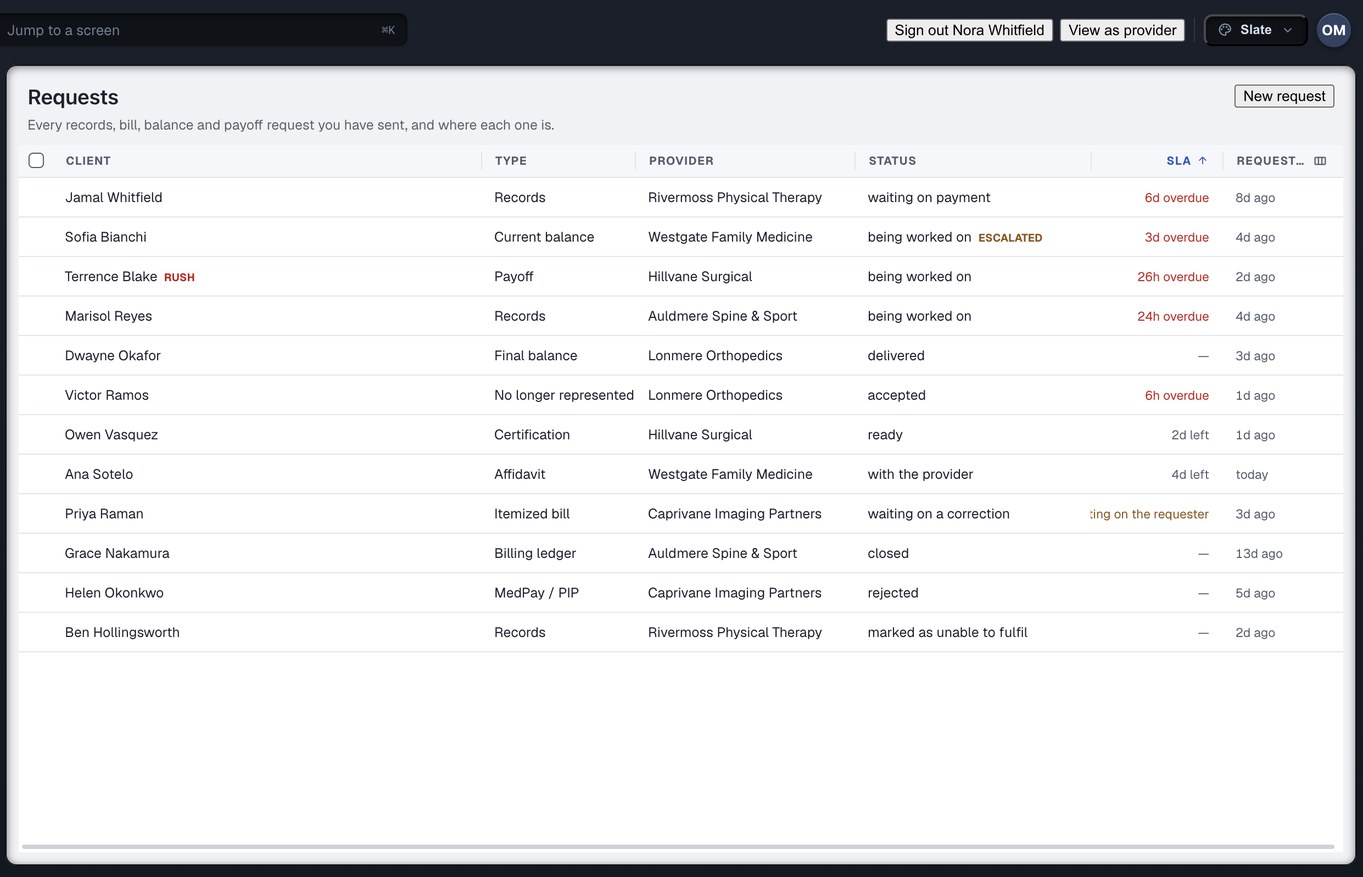
The records you are sent are the ones the firm actually holds, with the rest named
On the firm’s side of the same desk, every records request to a clinic carries a ticked list of materials and a date-of-service window. When four of six arrive, the request sits in a state of its own with the two outstanding items named, and “the rest does not exist” is a separate ending rather than a guess. So before a file is transmitted to you, the firm can read what is in it and what is still at the clinic — and tell you.
- What you are sent is recorded as a materials set: the day it went, each item with its kind and page count, and the transmittal letter
- A second and third delivery mid-review are ordinary. Everything ever sent folds into one list, deduplicated by document, because that list is the “facts or data considered” a testifying expert has to disclose
- The product does not read the chart for you. Whether it is complete enough to opine on stays your judgement and the firm’s; what changes is that neither of you is guessing about what is missing
What this means for you: you are not writing an opinion on half a chart without anyone saying so.
What is disclosed to you is scoped by a grant, not by an email attachment
Each item in a materials set is a document, and a document reaches you as a grant: issued to you by name — you, your organisation, or a bare email address if you have no account — for a specific version of the document, with an expiry of thirty days at most, a use count, and a mode that is either view or download. An emailed link is a bearer token that outlives the relationship and cannot be counted or withdrawn. A grant can be revoked, stops on its own, and records every time it is used.
- A grant names a version. One issued on Monday against a chart does not silently start serving Tuesday’s corrected copy; you were given specific pages
- Where the firm stamps pages, the stamp can carry your organisation’s name and the grant that produced the copy — so a page that resurfaces says which grant it came from, and a copy that was never yours cannot be attributed to you
- Said plainly: once a download is on your disk, revoking the grant stops future access and nothing else. That is why view is the mode a firm is nudged toward
What this means for you: you know exactly what you hold, the firm knows exactly what it gave you, and it is the same list.
Your fee, your retainer, your invoice
Your terms are recorded as agreed, and the letter governs, not the last quote
Fee terms are a shape, not a paragraph: one or more rate lines — hourly for review, a day rate for trial, a flat fee with its scope written in your words — the retainer and whether it is refundable, a minimum time, the expenses policy, when you are paid, and whether your compensation depends on the outcome. That last one is recorded as none, declared, or unstated, and unstated is never quietly promoted to none.
- A quote is a price on a day. Past its good-through date it is a starting point, and the screen says so. An engagement letter with no fee terms is refused
- Eight things the product says out loud about a quote before the letter is signed, among them: trial testimony not priced for a testifying expert, an activity priced by two lines, no cap, a deferral to settlement that is not secured by a letter of protection
- Deferral is not contingency. A fixed fee paid out of the settlement is drawn as a payment timing; a fee whose amount depends on the outcome is drawn separately and loudly. One word over both would misstate every letter-of-protection engagement
- Money is whole cents and whole minutes, never a decimal hour. 4.1 hours at $625 is $2,562.50 exactly, on your screen and the firm’s
What this means for you: the arrangement you agreed is the arrangement every later invoice is read against, and a gap in it is named before you start work, not discovered on the bill.
Your invoice is recorded as billed, compared to the terms, and never rewritten
Every amount you billed stays as you billed it. The product computes what the agreed terms imply and reports the difference, with both figures in the sentence — a conversation to have with you, which ends in a revised invoice, a written explanation or an agreement. None of those is reachable from software that silently substituted its own arithmetic. There is no reasonableness judgement: whether four hours to read a ninety-page chart is fair is between you and the lawyer.
- Ten checks, each a fact about the invoice: a total that disagrees with its own lines, work the terms do not price, a line above the agreed rate, a receipt missing, a duplicate line, a retainer applied twice. The total is reported, not corrected
- A not-to-exceed is cumulative or it is nothing. Three invoices that each pass a cap on their own are checked against what was already invoiced on the engagement
- An engagement cannot be closed over an unpaid invoice. The only ways out of “waiting on payment” are paid or withdrawn, and both say something true. An invoice dispute is a condition on the record, not a state it hides in
- A step out of order is refused in a sentence — “An engagement that is on the shortlist cannot be invoiced.” Nothing is written, and nobody has to guess why a button is grey
What this means for you: the invoice argument in month four is a reading exercise against a record you both hold, not a memory contest with a paralegal who has left.
You are an account, so a firm’s engagement of you is one record both of you read
There is no status column. Where an engagement stands is folded every time from the log of what happened — sent for a conflict check, cleared, quoted, engaged, sent materials, started, given work product, invoiced, paid — and the acts that are yours are recorded as yours: declined by the expert, quoted, delivered their work, withdrawn by the expert. A status field beside an audit trail is two records that can drift apart, and the one people trust is the one that is wrong.
The expert is one of the product’s 37 roles, in the family it calls partners — an account in your own organisation, not a row in a firm’s address book. A firm’s data reaches you only by a delegation the firm issues, which names what it covers, carries an expiry that cannot be left blank, and grants no seat at any provider ranking. What the firm has not delegated, you cannot see, and revoking the delegation takes it away.
Said honestly: in this build the partner family has no desk of its own. The engagement is recorded on the firm’s Experts screen, and what reaches you today reaches you as a grant. The record is one; the second chair to read it from is designed and not yet drawn.
Counted from the build, not from a case study
Facts about what exists. We have no expert outcome figures, no time-saved figures and no testimonials, and this page prints none.
Eighteen states, in the words the screen uses. Which acts are yours.
The firm’s Experts desk keeps every engagement on its stations from the first search to the last payment. Read from your side, the stations fall into three stretches, and every state below is drawn on screen in plain words — never as a code.
Before you are retained
On the shortlist → waiting on the conflict check → cleared for conflicts → waiting on a quote → quoted → engaged.
While you hold the file
Sent the materials → working → delivered their work. A rebuttal report after the first, or trial testimony months after the report was paid for, is the same engagement, not a new one.
Getting paid
Waiting on payment → paid → closed. What was invoiced, what was paid and what is outstanding are folded from the log, never from a running total on a row.
The six ways it ends, and what each one says
Closed
The work is done and nothing is owed. Reached from paid, or from delivered work that was inside a retainer already paid.
Blocked by a conflict
A bar was found, before or after engagement. Permanent, with the finding on it. The screen’s own words: “this record stays as it is.”
Declined by the expert
You said no, and the reason you gave is on the record. Nothing about it is scored, and it is not a mark against you anywhere.
Passed over
The firm chose someone else, with its reason written down. The firm’s own history with you counts engagements and dates; it has no notes field to become a rating.
Expired at the quote stage
Your quote’s good-through date passed with nobody acting on it. A price on a day is not a price forever, and the record says which day.
Withdrawn
By the firm or by you, and the record says which. Nothing is erased: the materials list, the invoices and the clearance all stay readable.
Nothing on your profile is a verdict about you
Whether an expert is any good is decided by a judge on a Rule 702 motion and by a jury after cross, on a record this software will never see. Anything the product printed beside your name would be read as its opinion of that answer. So there is no rating field, no function that computes one, and a test that fails if anyone adds either.
Three were proposed and refused, for reasons the module states in its own words, put plainly here:
- A star rating from firms. Firms rate the outcome, not the work. An economist whose model held up perfectly on a case that settled low gets three stars, and the next firm reads that as an opinion about the economist. It would also make the product a publisher of statements about a named professional’s competence.
- A win rate. It is a statement about lawyers and juries wearing your name. Worse, it is discoverable and cross-examinable: “you are listed on a service that advertises your success rate to the firms that hire you” is a question no expert should have to answer because of us.
- A Rule 702 exclusion rate. The tempting one, because the orders are public and material. So they are kept one by one, each with its citation so a lawyer can pull it, and never reduced to a rate and never read by search. “Excluded two of nine times” averages a state-court limine ruling, a federal exclusion and a withdrawn motion into a number that means nothing in any of the three.
Four things this deliberately is not
Being clear about the edges is how you can trust the middle.
Not a listing you pay to be in
There is no paid placement and nothing to buy your way up. A firm’s shortlist is ordered by fit to its brief; an expert with no published rate is cautioned, not excluded and not demoted. Your profile is a record of what you have asserted and what has been confirmed, and the firm’s history with you is the firm’s alone — never aggregated across the network, because it would publish one firm’s bench to its opponents.
Not a scheduling or deposition tool
Your availability, next free date and blackout weeks are facts on your profile so a firm does not retain you into a trial week you already have. The product does not book you, run the deposition or hold the transcript. It records that deposition testimony was engaged and billed, on the same engagement as the report, months later.
It does not write or review your report
Work product is recorded, never opened: its kind, title, page count, delivery date, what it supersedes, and whether it is produced or protected — which stays undetermined until a lawyer decides. Nothing in the product assesses an opinion, summarises a chart into a narrative, or drafts a word of what you sign.
It is not a judge of your hours or your fee arrangement
An invoice is compared to the terms and the difference reported; whether the time was reasonable is a conversation between you and the lawyer. Whether an outcome-contingent fee is lawful in a given court is not decided here either — the product makes the arrangement impossible to overlook, and leaves the legal question where it belongs.
The six that come up first
Do I need an account to be engaged or to receive materials?
Not to receive materials: a document grant can be issued to an organisation, a person, or a bare email address, and it carries the same expiry, use count and audit either way. The expert is one of the product’s 37 roles, so when you hold an account the engagement is recorded against it. In this build there is no expert-side screen — the record lives on the firm’s Experts desk, and we say so rather than drawing one that does not exist.
A new defendant was joined after I delivered my report. What happens?
The engagement is suspended for a conflict review, even if your report has been paid for, because a clearance only covers the parties it was run against. A fresh check is run against the current party list; a new clearance resumes the engagement where it was. If the check finds a bar, the engagement ends as blocked, with the finding on it, and the firm’s refusal sentence names why.
Can a firm waive a conflict on my behalf?
Only a waivable one, only in writing, only naming that specific finding, and only with somebody’s recorded consent — the client’s, and for some conflicts the adverse party’s too. A waiver that names nobody’s consent is not a waiver. Six kinds of finding are disqualifying and cannot be waived by anyone; the screen’s own words are “no waiver changes that.” A waived clearance is recorded as waived, never relabelled as clear.
What happens when the firm thinks my invoice is wrong?
Your figures stay as you billed them. The product reports each difference against the agreed terms with both numbers in the sentence — the rate on the letter and the rate on the line, the cap and the cumulative total — and the firm records a dispute against that invoice. A dispute is a condition on the engagement, not a state it disappears into, and the engagement cannot be closed until the invoice is paid or the engagement is withdrawn.
Will firms see a rating, a win rate or how often I have been excluded?
No. There is no field for any of them and no function that computes one. Past challenge rulings are shown as individual orders with citations, never as a tally. A firm sees its own history with you as counts and dates, with no notes field, and no other firm sees it. What a firm can check — your credentials and who confirmed each one, your admissions, your availability, your rate card, your Rule 26 list — is what the profile carries.
Is this a listing I pay to be on?
No. It is not a listing. There is no paid placement, and search measures how well you fit a firm’s brief rather than anything about you in the abstract. A treating surgeon with three depositions is the right expert for plenty of cases, and the product does not rank a longer CV above an available one.
Ask to see an engagement from your side of it.
Talk to our team about how a firm’s engagement of you is recorded — the check, the grant, the terms and the invoice — and what reaches you at each station.
The same desk from the attorney’s chair: Read the firm side → · Running a clinic? The provider side → · How the record is kept: Technology →