You answer for the practice’s standing. Here is what it is computed from.
Your acceptance time, your fulfilment time, your overdue rate and the firms that owe you are read off the request log, not typed in by anyone. Every figure says what it is a figure of. Your clock stops while you wait on the firm. And when a delay sits on Omnis’s own desk, it is scored against Omnis, not against you.
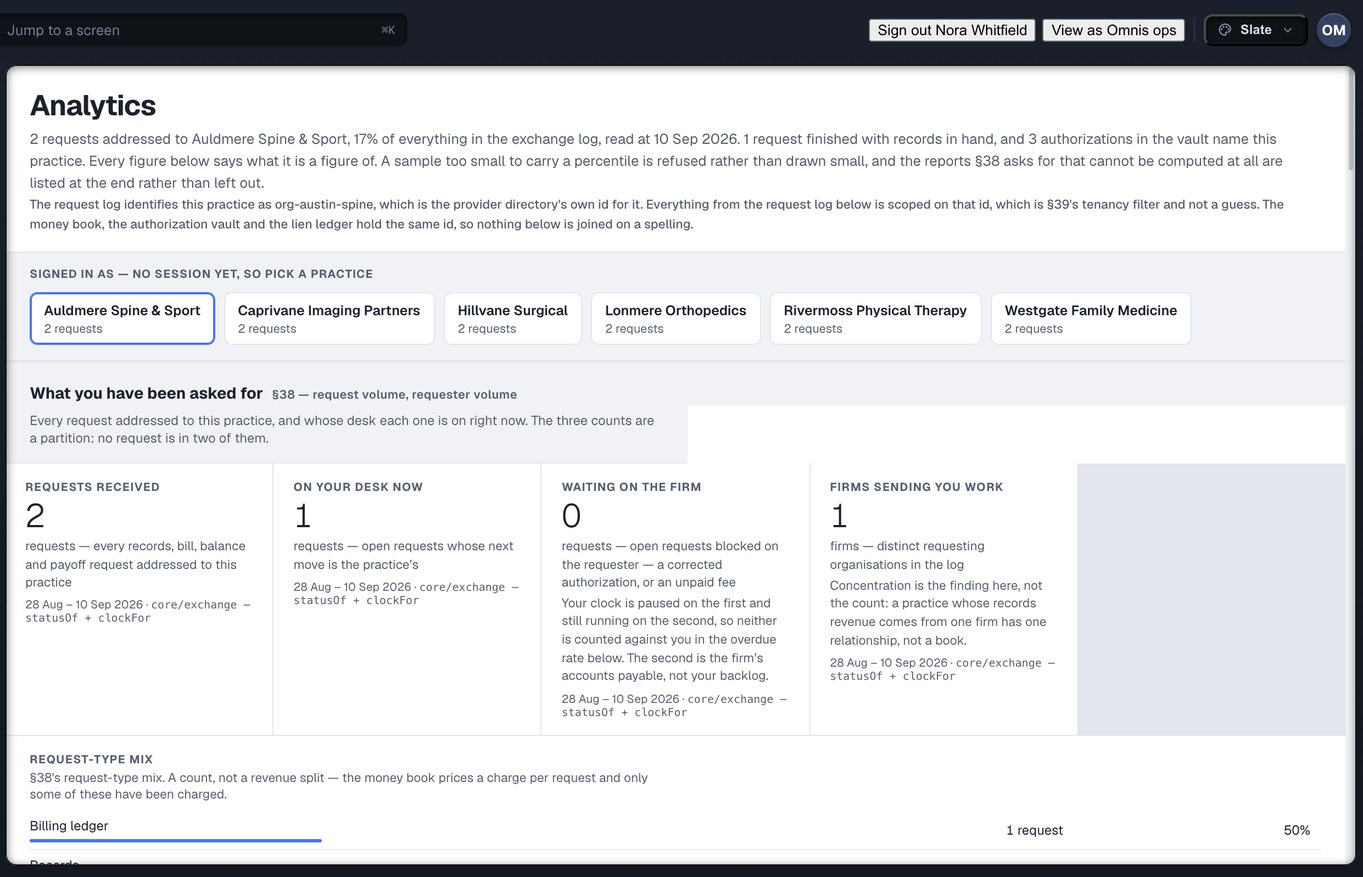
Captured from the running build, 24 September 2026. Demonstration data — every name, matter and figure is a fixture, not a real client, clinic or balance.
Three questions the owner gets asked, and cannot answer from a fax pile
Whoever answers for the practice is asked these by a partner, by a firm, or by an accountant. Each one has an honest answer somewhere in the building, and none of it is written down anywhere the asker can read.
“Are you slow?”
A firm says your practice is slow. You know it is not, because you know the request sat eleven days waiting on their corrected release. But you have no number, they have no number, and the version that survives is theirs. The label sticks and there is nothing to appeal to.
“Do we keep treating for this firm?”
A firm sends a new patient on a lien. Nobody in the building can say what that firm was billed on the last four, what it paid, or how long it took. The decision is made on somebody’s memory of a phone call, and the person with the best memory is on holiday.
“Who can see the payout account?”
One shared login for the release desk, the billing desk and the front desk. The person who checks patients in can read the fee schedule. The person who left in March can still read everything. Switching them off is a support ticket to somebody else’s help desk.
Eight mechanisms, read from the owner’s chair
The records desk and the billing desk have their own pages. This one is about the things only the person who answers for the practice has to care about: what is said about you, who owes you, who in the building can see what, and what a fee rule is allowed to be.
Your standing is explained, not scored
There is no star rating and no rank. Analytics is twelve reports about your practice, and every figure in them is one of a few fixed shapes, none of which can be drawn without three things: what the number is a number of, in words; the window it covers; and which engine produced it. “50%” is not a figure here. “50% of the two requests this practice finished with records in hand, 28 August to 10 September” is.
- A ninetieth percentile off a handful of requests is refused outright rather than drawn small
- A report the data cannot support stays in the list, saying what is missing and what would close it
- The firm’s reports about you and your analytics about yourself are computed from the same log — two screens cannot disagree, because there is one derivation
What this means for you: when a firm says you are slow, the answer is a sentence with a denominator in it, and both of you are reading the same one.
The clock stops while you wait on the firm
When your records desk sends a request back for something — a release that does not name your facility, a missing signature, a blank date range — the request is waiting on the firm and your clock is paused until they answer. Hours actually held, with every paused interval excluded, is the number your fulfilment time and your overdue rate are computed from. The wall-clock age is shown beside it, because it is a fair question; it is simply not the one you are judged on.
- The clock also stops at the moment your desk finished, not when the firm got round to downloading
- A request you have finished and invoiced, where the firm owes the fee, is counted as the firm’s accounts payable and kept out of your overdue rate — and the screen says so, because that clock is honestly still running
- Your turnaround is measured over the requests that ended with records in hand, so the speed of your own refusals cannot flatter it
What this means for you: the incentive runs the right way. Your desk sends a defective release back instead of fulfilling around it, and nobody pays for that in the numbers.
When the delay is Omnis’s, it is scored against Omnis
Some requests never reach a practice as an Injury Docs request at all. A firm orders records from a clinic that is not on the network, and Omnis’s own retrieval desk works it by fax, portal or mail. That clinic agreed to no clock and cannot see a queue it has never signed into, so every late row on that work is scored against Omnis, worked by Omnis’s desk, and never shown to the clinic as theirs. A practice on the network directly owns its rows, as it agreed to. Where nobody can say whose delay it was, nobody is scored.
- The firm sees one status model whichever way the records came; the attribution is never unified, because that would be a lie
- Who is handling a problem and who owes the outcome are two separate facts on every support case, and the second never moves
- You arrive at your own onboarding call unrated, rather than already carrying a retrieval agent’s backlog
What this means for you: the only numbers on your record are for work you accepted, on a clock you agreed to.
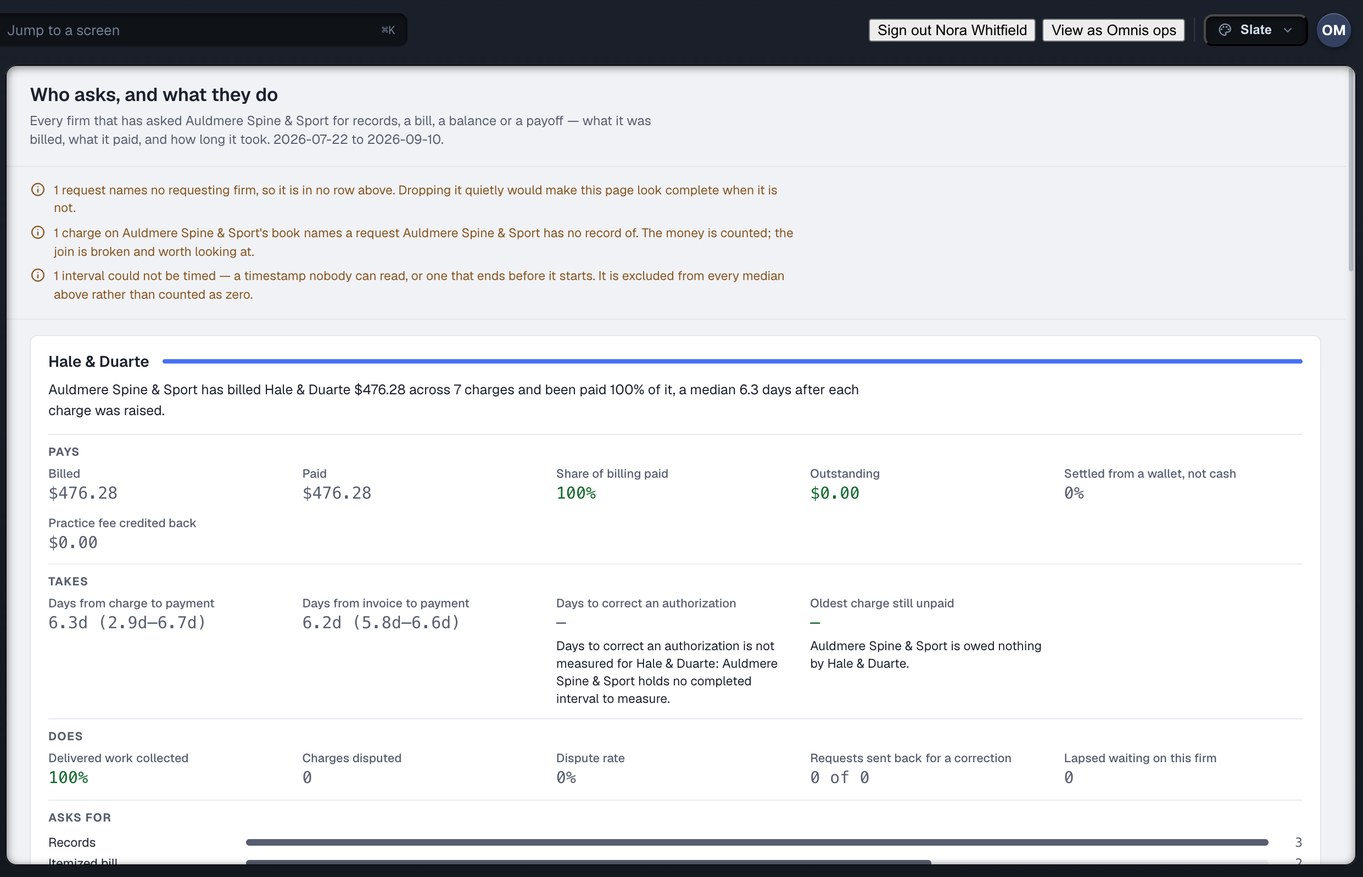
Who asks: what each firm was billed, what it paid, how long it took
A law firm’s software has always been able to say which adjusters pay and how fast. Nothing in this industry has answered the same question from your chair. Who asks is that question inverted: for every firm that has asked your practice for anything, what it was billed, what it paid in cash rather than in platform credit, what is still outstanding, how many days from charge to payment, how many days to correct an authorisation, what it disputed, and what it lets lapse while the next move was its own.
- Under three observations no rate and no median is printed — totals and counts always are, because a ledger total is yours whatever the sample
- Every firm gets one sentence naming both parties that you could forward to that firm without editing it
- Measures it refuses to compute are written down with the reason: no “average cut accepted”, because a refund for another patient’s pages is a correction and not a concession; no bounced-card rate, because one firm’s card failing is not a fact about one clinic
What this means for you: the decision to keep treating on a lien for a firm is made on what that firm did, on a screen, rather than on what somebody remembers.
Nine roles, each one a set of grants
Owner, Admin, Office Manager, Records, Billing, Finance, Clinician, Scheduling and Read-Only. A role is not a title; it is a template that says which screens, which kinds of record, which verbs, how much of the money and how much of the network a person reaches. Money is its own axis, separate from the screens, which is what lets a records clerk see the invoice on the request in front of them without seeing the fee schedule behind it.
- Five money rungs — none, amounts, rates, settlement, full — so a refusal is one sentence: “your financial access is Amounts and this needs Rates”
- Read-Only can look at the queue on screen: no money, no changes, and no download, export or print, because a copy that leaves the building is a different act from reading
- There are no deny rules. Every refusal is an absence with a name, and narrowing somebody is done by issuing a narrower grant, never by subtracting from a wide one
What this means for you: the front desk sees the queue and not the payout account, and you can say in one sentence why.
Locations and departments, including the one that spans every site
A role says what a person may do. Where they may do it is a separate fact, set when the role is assigned: which organisation, which location, which department, which matters. Locations form a tree — a region, a building, a service line — and a grant that reaches a region reaches the clinics inside it. Departments are kept separate from locations on purpose, because they cross: a central Release of Information department spans every site, and one site hosts several departments.
- Two office managers at two sites do not see each other’s work unless somebody grants it
- A multi-site practice or a hospital system is one account with a tree inside it, not forty accounts each delegating to a central desk
- A grant names exactly one organisation and there is no way to write one that names two, so a stranger’s chart is unreachable by construction rather than by a check somebody remembered to add
What this means for you: the org chart you actually have — sites, a central records department, a billing desk — is expressible without pretending it is flat.
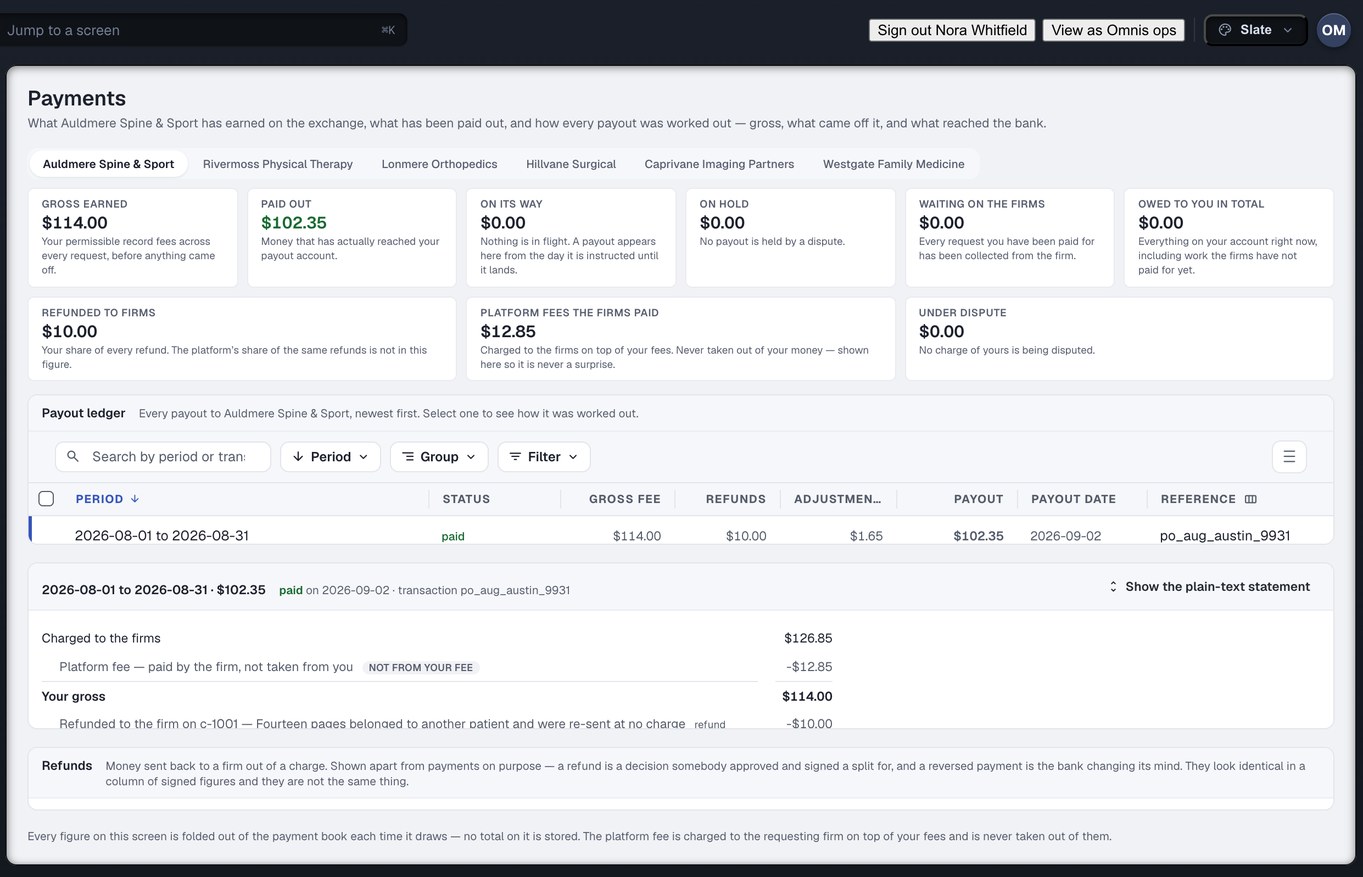
Fees and the payout account, with the reviewer’s name on every rule
What a practice may charge a firm for a copy of a chart is set per state, by statute or schedule, and it moves. So Injury Docs ships no default fee schedule and no fallback. Every rate arrives as a rule that names who reviewed it, on what date, against what authority — a rule without a reviewer cannot be written. A state with nothing reviewed produces “cannot be priced” and a reason, never a plausible-looking number. Your fee rules and your payout account live in Settings, and neither has any effect on where a request sits in anyone’s queue.
- Every component of a rule is required: certification, affidavit, media, each delivery medium, rush. “Not offered” and “free” are different answers and a rule has to give one
- Every line on a quote says how it was arrived at and which clause produced it, so a dispute months later is settled by reading, not by re-deriving
- A price set by hand wraps the original rather than replacing it: the engine’s figure, the override, the reason and the approver all stay readable
What this means for you: when a firm disputes a charge, “which rule did this come from” has one answer with one name on it.
The referral that arrives with a firm behind it
A firm cannot send a referral without a signed authorisation attached, a named contact at the firm rather than the main line, the number the client actually answers, the date of injury, the body parts affected and the service being asked for. The letter of protection arrives as a status on the packet. And a referral that goes wrong — a no-show, a client nobody can reach, a slot that needs moving — is not a grey row that drops out of a filter. It is an open state that owes somebody a next move, with a name and a due time on it.
- The firm owns the client and the provider owns the appointment: a client you cannot reach goes back to the firm on the first failure, because they hold the number that gets answered
- A rescue that has failed twice is not tried a third time; it goes to the firm for a decision
- The referral engine is built and tested; the provider’s Referrals screen is not yet, and the destination on the rail says so in a sentence rather than drawing an empty table
What this means for you: a referral is a firm that has already done its paperwork, and a missed appointment is somebody’s job rather than nobody’s.
Counted from the build, not from a case study
Facts about what exists, counted on 24 September 2026. We have no revenue, time-saved or turnaround figures for any practice, and we will not print a guess.
Four destinations that are yours, and what each one is today
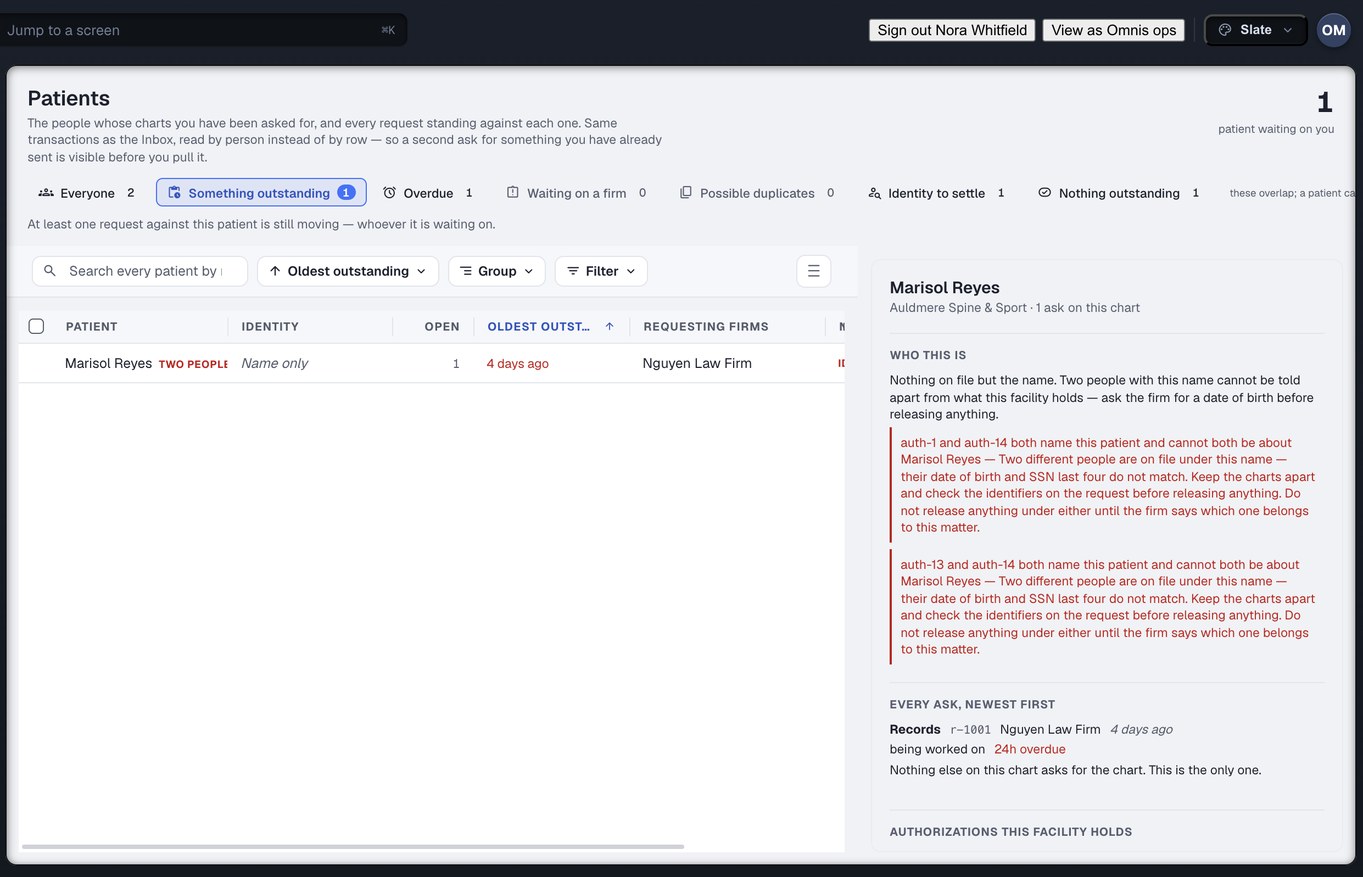
The release desk works the Inbox and the billing desk works the ledger. These are the four the person who answers for the practice opens, shown as they render in the build on 24 September 2026 — including the two that are still a promise, which say so on screen.
Analytics
Acceptance time, fulfilment time, overdue rate and requester mix, measured from the record. Not entered by anyone.
Who asks
The mirror of Analytics. That one measures how your practice performs; this one measures the firms asking.
Settings
Your organisation, locations, departments, fee rules and payout account. On the web app, Settings holds your People today: invite colleagues with a one-time link and remove anybody who leaves. The other settings are not connected yet, and are not shown.
Referrals
Incoming referrals from law firms: accept, schedule, report back. The destination is on the rail and says, in a sentence, that the screen is not built yet.
Nine roles, and what each one cannot see
A role list nobody can interpret is the same as no role list. Ten titles tell an office manager nothing she did not already guess, and the guess is where the damage is. So each role here is read for its refusals as much as its permissions — and the money column is the one to check first.
Two verbs — overriding a refusal and acting as somebody else — are reachable by no role at all. They exist only through a recorded ticket that cannot produce an allow without also producing the record of it.
Create your practice accountMoney is one of five axes on a role — screens, kinds of record, verbs, money, and the network — and the place a person may act (organisation, location, department, matters) is set when the role is assigned, not baked into the title.
Four things this deliberately is not
Being clear about the edges is how you can trust the middle.
Not practice software
Injury Docs is the exchange between your practice and the law firms that ask it for things. Scheduling, encounters, clinical notes, charge capture and the rest of running a clinic are your practice software’s job, and this does not try to be it. The Patients screen is records: whose charts have been asked for, and every request standing against each one.
Not a listing you buy attention in
Requests are worked oldest and most overdue first. Your fee rules and your payout arrangements have no effect on where a request sits in anyone’s queue, and nothing a firm pays moves it either. A practice profile is a record of what you do, which languages your staff speak and what is on your premises — not a placement.
Not a scorecard you cannot read
There is no single number for your practice and no rank against other practices. There are figures, each with its denominator, its window and the engine that produced it, and there is a list of the figures the data cannot yet support. A rating you cannot interrogate is a rumour; this shows its working, including where it has none.
Not a replacement for how work reaches you today
The fax line stays on. What changes is what happens to the work that does come through here: a state, an owner, a clock, a record of what was sent, and a ledger the firm reads too. Firms that are not on this keep sending the way they send now.
The six that come up first
What does a law firm see about our practice?
Figures computed from the same request log your own analytics are computed from — fulfilment time, overdue rate, what happened on each request — with hours you spent waiting on that firm excluded, and the paused interval visible to them too, so they can see the delay was on their desk. Nothing is a stored status, so what they read and what you read cannot disagree.
A firm still owes us for the last four requests. Can we see that before we accept a fifth?
Yes. Who asks lists every firm that has asked your practice for anything, busiest payer first: billed, paid, outstanding, the oldest charge still unpaid, and — once there are at least three observations — the share of billing paid and the median days to payment. The oldest unpaid charge is shown even on a book of one, because it names a specific charge rather than summarising many.
Can the front desk see what we charge, or the payout account?
Not unless you give them a role that reaches it. Money is a rung on every role, separate from which screens the role can open. Scheduling and Clinician sit at none; Records sits at amounts, which is the invoice on the request in front of them and not the schedule; Billing, Admin and Office Manager sit at rates; Owner and Finance at full. A refusal says which rung the person has and which one the thing needs.
We have three sites and one central records department. Does that fit?
That is the shape it was built for. Locations are a tree inside one account, and a department can either sit at one site or span the whole organisation. A grant that reaches a region reaches the clinics inside it; a grant to one site does not reach the others. Two accounts can never be joined by a grant, so a hospital system that acquires another is a merge with a paper trail, not a link.
Who decides what we may charge for records?
Your state does, and a named person confirms it. There is no built-in fee schedule: every rule carries who reviewed it, when, and the authority it was reviewed against, and a request in a state with nothing reviewed is reported as unpriceable with the reason and the next step. Your own configured fee for your practice is one of the things a rule can be scoped to. The example rules in the build say on screen that no lawyer has reviewed them.
What is actually built today, and what is not?
Records requests run between real organisations on the web app: a firm on Injury Docs sends one, and your desk accepts it, works it and records how the records went. Analytics, Who asks and most other screens run on the desktop build’s local record and are not live on the web yet; they say so rather than show another practice’s data. The roles, the location tree and the fee-rule shape are in the engine and under test. The practice’s Referrals screen is declared and not yet drawn, and says so. There is no mobile app. We would rather you read that here than discover it on a call.
Bring the firm that still owes for the last four.
Create your practice account, give the front desk the queue and the billing desk the ledger, and read what your standing is actually computed from — with every interval that was never yours to answer for taken out.
Work the release desk or the billing desk? Read the provider page → · Holding letters of protection? How a reduction is negotiated on the record →