Two roles, one job each. Everything else stays off your desk.
A records request is worked by the release desk, under a release that was checked first. A referral from a law firm arrives with the authorisation, the order and the number the client actually answers; you accept it, book it and record that they were seen. When a patient rings to ask where their records are, the answer is one screen. And nobody here ever asks a clinician what they think.
Captured from the running build, 24 September 2026. Demonstration data — every name, matter and figure is a fixture, not a real client, clinic or balance.
Everything reaches the wrong desk first
A clinic that treats on a lien has two people the legal side keeps interrupting, and neither of them is the person who can answer. None of these three is about anyone being slow.
The doctor gets the records call
A paralegal rings for a chart. The front desk cannot say where it is, so the message goes to the clinician, who has nothing to add: the release is not theirs to check and the chart is not theirs to copy. The call cost a treating hour and moved nothing.
The referral is a fax with a name on it
It says who and roughly why. It does not say what the firm wants done, which language the client is comfortable in, whether they need a ride, or the number they actually pick up. The first visit gets booked against the number on the intake form, which is the one they do not answer.
The no-show goes grey
The patient misses the first visit. In the systems firms use today the row changes colour, drops out of the default filter, and nobody at the firm or the clinic owns the next call. Six weeks later the gap is in the file. The status was accurate the whole time; accuracy was never the problem.
Six mechanisms. Three keep work off the clinician; three give the front desk one job.
Injury Docs is one system the firm and the clinic both open. For these two roles the point of that is not what it shows you. It is what it routes around you.
A records request is not a clinical question
The request names materials and a dates-of-service window. The release desk checks the release before a page leaves the building — that it names your facility, covers the dates, covers the records asked for. The request moves through 21 states, and not one of them waits on a treating clinician.
- The authorisation check runs before anything is disclosed, and it is not your check to run
- “Ask for detail” and “Ask for a corrected release” are the desk’s verbs, not yours
- The fee, the invoice and the schedule are not on a clinician’s screen at all — a clinician who can read the fee schedule is a clinician who can be asked about it
What this means for you: the only records request you ever see is one somebody chose to show you.
A referral arrives as a packet, not a name
What the firm sends: the client’s name, date of birth and the number they actually answer; their preferred language, and whether they need an interpreter or a ride; the date of injury and the affected areas in the firm’s own words; the letter-of-protection status; the attachments; the order — one of 100 named services, a requested physician, whether virtual, whether stat, any instructions — and who at the firm to call. A referral cannot be sent without an authorisation on it.
- 100 services, 10 languages and 13 attributes the firm can name — the same words a paralegal already uses
- The number the client actually answers is a required field, not a courtesy
- The firm contact is on the packet — a name, a role, a phone and an email — so a question has somewhere to go
What this means for you: accept or decline is a decision you can make from the packet — and a decline now is more useful to the client than a slow yes.
Nobody asks what you think
Thirteen kinds of ask a firm can raise: records, an itemised bill, the ledger, a balance, a final balance, a payoff, an affidavit, a certification, a status, a no-longer-represented notice, MedPay and PIP, and imaging. Not one of them is a summary, a narrative or an opinion. Writing the medical narrative out of the records is MedChron, a different Omnis product, and it is not wired to your desk.
- There is no free-text “tell us about the treatment” ask, and none is planned
- A request carries a list of named materials, not a paragraph for somebody to interpret
- A “status” ask is the firm asking where a request is, not how the patient is doing
What this means for you: your involvement with a firm’s request is nothing, unless your signature is the thing being asked for.
Accept, book, record the visit — and the diary stays yours
Three acts. Accept or decline within 24 hours of the referral arriving, and within eight once you have opened it. Book: record that a time exists — or that the client is booked and the slot is to follow. Record: within 24 hours of the appointment time, say whether they attended. The firm reads each of those as it happens instead of ringing to ask.
- The appointment lives in whatever you use today — Injury Docs records that it exists and when; it does not run your diary and does not try to
- A booking with no time is recorded as booked and chased after a week, rather than refused
- Scheduling time is measured from acceptance to the first confirmed booking, not to the appointment date — a clinic three weeks deep in bookings is busy, not slow
What this means for you: nothing here replaces your scheduling system. It replaces the phone call the firm makes to find out what happened.
The one thing with your name on it
A business-records affidavit or a custodian certification is its own request, addressed to a named custodian — and in a small practice the custodian who signs records is often the treating clinician. It comes to you filled from the record already on the request: the patient, the practice, the dates of service, the page count of what was sent. The firm supplies its own form. You swear it before your own notary exactly as you do now, and the sworn copy goes back on the same request.
- A certification is an affidavit without the oath, and the product treats the two as one pair
- “Defective” is a state: if the firm says the affidavit will not do, they must say why, or the next act is theirs, not yours
- The corrected copy replaces it; the first one stays in the log and is never the copy attached to a demand
What this means for you: your name goes on a form you read, not on a field somebody typed.
A no-show has an owner and a clock
Four things can go wrong with a referral — declined, unreachable, no-show, reschedule needed — and every one of them stays open. There is no way to reach the end of a referral by failing; the only endings are a human closing it or the firm withdrawing it. Each failure has an owner, an act, a sentence and a due time.
- No-show: you offer another time within 24 hours. A cancellation nothing has replaced: 48
- Unreachable: the firm rings the client within 24 hours, on the number they hold — you are not asked to try the same wrong number again
- After two failed rescues since the client was last seen, the referral goes back to the firm for a decision, not a third attempt — and the count resets every time care actually happens
What this means for you: the patient is never the owner of a step. Somebody with a phone always is.
Counted from the build, not from a case study
Facts about what exists, counted on 24 September 2026. We have no no-show, attendance or time-saved figures for any clinic, and we will not print a guess.
Two screens, and one of them is not yours
The front desk lives on Patients. The clinician mostly does not live anywhere here, which is the point — but it is worth seeing the screen the release desk works, so you know what never reaches you. Every capture below is from the running build on demonstration data.
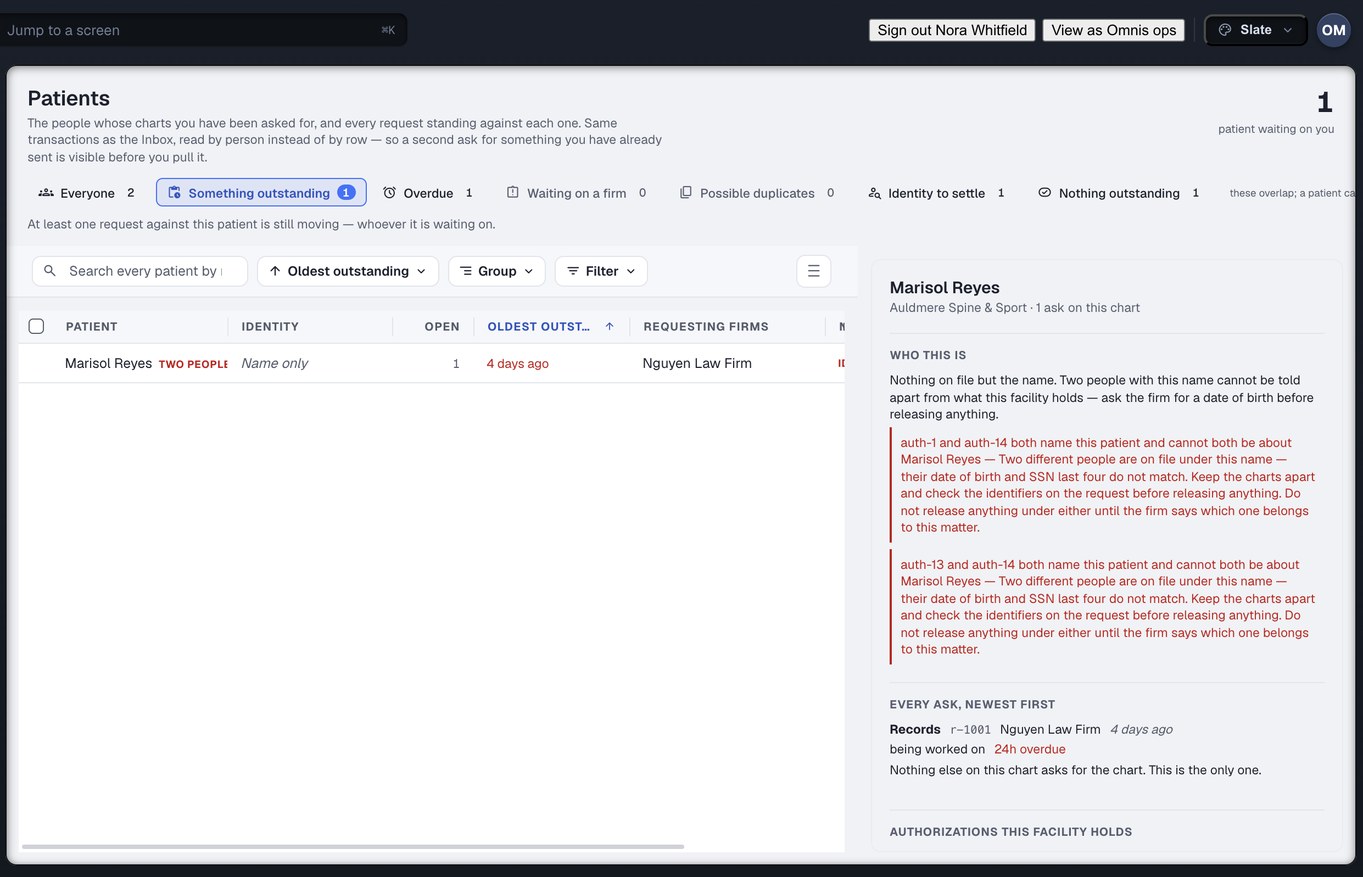
Patients — when somebody rings about their records
The people whose charts have been asked for, and every request standing against each one, newest first, with whose act it is waiting on. Search by name. Seven queues: everyone, something outstanding, overdue, waiting on a firm, possible duplicates, identity to settle, nothing outstanding. A patient asking “where are my records” gets an answer from one screen, not from a message to the back office.
In this capture, two people are on file under one name. The product says so, in red, and says not to release anything under either until the firm states which one this matter is about. That is a front-desk problem every clinic knows, and here it is a finding with a remedy rather than a mistake somebody makes on a Friday.
There is no screen for the patient, and none is planned. They ask you, or they ask their lawyer. What we tell injured people →
Captured from the running build, 24 September 2026. Demonstration data — every name, matter and figure is a fixture, not a real client, clinic or balance.
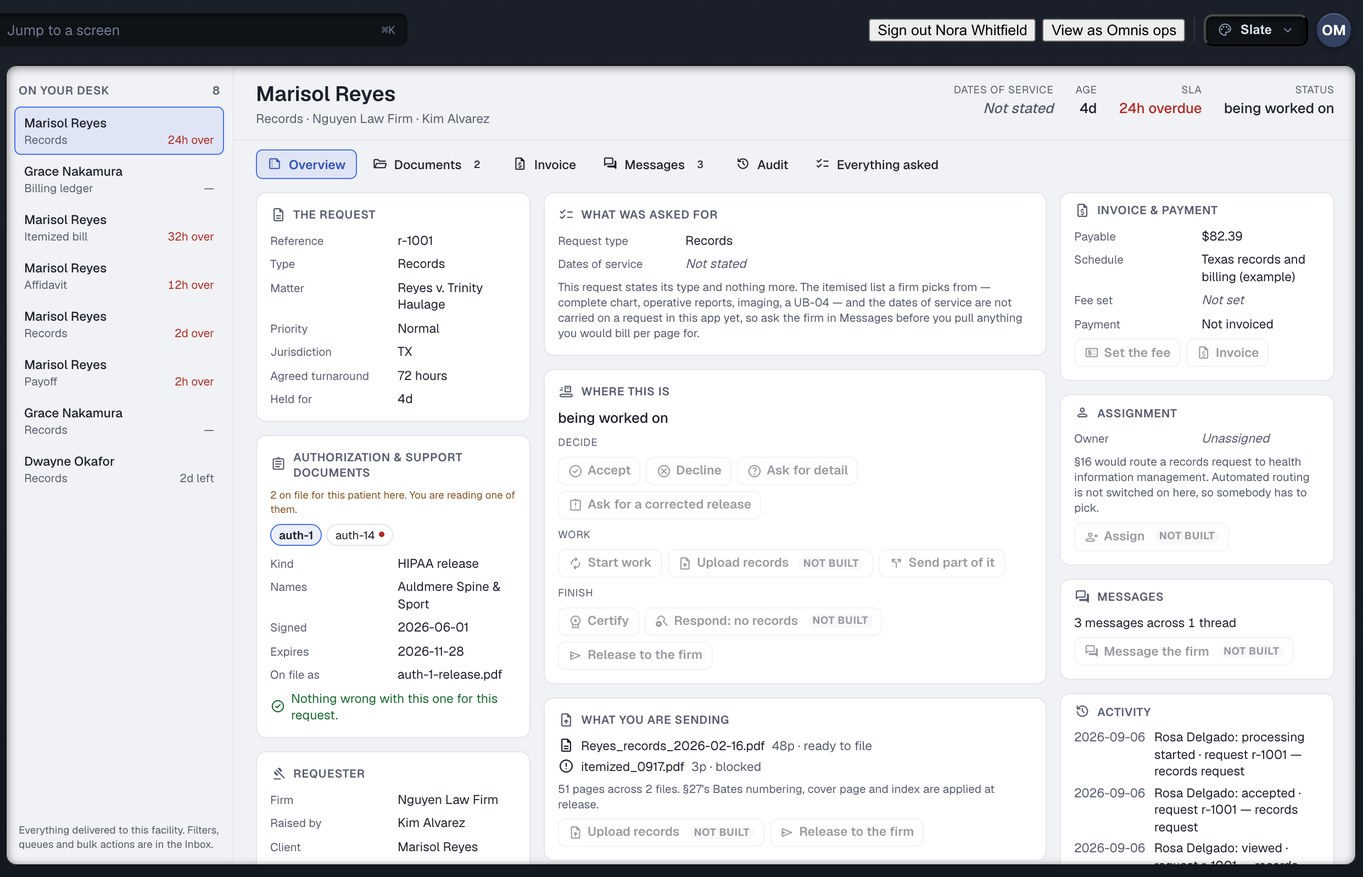
Captured from the running build, 24 September 2026. Demonstration data — every name, matter and figure is a fixture, not a real client, clinic or balance.
Records — the screen that is not yours
This is the release desk’s screen. In the capture a records clerk has started work, the release on file names the facility with its signing and expiry dates, and the product has already said there is nothing wrong with it for this request. The fee is set here, the invoice is raised here, the firm is asked for detail here. A clinician sees the chart and the request; the fee panel does not render for them.
Note the “Certify” button in the finish row. Pressing it on a records request tells the clerk, in a sentence, that a certification is its own request the firm has to raise. That separate request — addressed to the custodian, filled from the record — is the one that reaches you.
And a third role, for the person who needs to see the queue and never touch it
Read-only is one of the 37 roles the product knows. It can look at the inbox, the patients, the requests, the authorisations, the documents, the referrals and the reports — and do nothing to any of them. No changes, no money, and no copies out: download, export and print are not among its verbs. The practice owner who wants to see the week without being able to move it, or the associate covering a desk, gets exactly that.
What the product does when somebody no-shows
That question having a one-screen answer is most of the reason the referral engine exists. The table is the engine’s own rescue plan for each failure: who owns the next move, by when, and the sentence the row carries. The firm owns the client; the clinic owns the appointment. Every clock is counted in hours since the failure, and a clinic’s clock is pushed out by any interval it spent waiting on the firm to answer a question.
The ceiling is two rescues, counted since the client was last seen. A patient who attended six visits and missed the seventh does not inherit the history of a rough start — otherwise the longest courses of treatment would be the ones that escalate first.
Create your practice accountOffer another time in the next day. A missed appointment that is re-booked at once is a gap of days; one that is left is a gap the defence will read out.
The client rang to cancel rather than simply not turning up, so they are still engaged and easy to re-book today.
You have tried. The firm rings them on the number it holds, confirms they still want treatment, and hands the referral back for you to book.
The same packet goes to someone else — the authorisation, the attachments and the history travel with it, so it is one act and not the whole form again.
The referral leaves the clinic’s queue and lands with the case handler: reach the client another way, send it to a different clinic, or close it and put the treatment gap on the matter in writing.
Four things this deliberately is not
For these two roles the edges matter more than the middle. Each of these is a real product somewhere; two of them are ours.
Not your scheduling system, and not your EHR
A referral is accepted, booked and reported on here. The appointment itself lives wherever it lives today, and the encounter note is written wherever you write it. Scheduling, charting and clinical documentation are CarePro, a different Omnis product, and this one hands the appointment to whatever you use.
Not a medical-summary product
No ask in the product is “summarise the treatment” or “give us your view”. Injury Docs moves records and the permission to use them; writing the medical narrative out of those records is MedChron, a different Omnis product. A clinician is never asked to narrate, and that boundary is real.
Not a screen for the patient
The Patients screen is the clinic’s view of whose charts have been asked for. The injured person has no way in and none is planned. When they want to know where their records are, they ask the front desk or their lawyer — and the front desk can now answer.
Not a notary
The affidavit is prepared from the record and carried back on the request. It is sworn before your own notary, as it is today. Injury Docs does not administer the oath and never claims to.
The six that come up first
I am the treating provider. Do I ever have to review a records request?
No. A records request is a list of named materials and a dates-of-service window, worked by the release desk under a release the product checked first. A clinician can see the patient, the request and the chart, and can be asked nothing about the fee or the schedule, because those do not render for that role. The only request that comes to a clinician by design is an affidavit or certification for their signature.
A patient rings asking where their records are. What do I tell them?
Open Patients, find them by name, and read the row: every ask against their chart, which firm raised it, what state it is in and whose act it is waiting on. If the answer is “waiting on the firm for a corrected release”, you can say so. There is no screen for the patient, so you and their lawyer are the two people who can answer, and now you both read the same fact.
The client speaks Spanish and needs a ride. Does the referral say so?
Yes. Preferred language, whether an interpreter is needed and whether transport is needed are fields on the packet, alongside the number the client actually answers, the date of injury, the affected areas in the firm’s words, the service being ordered from a list of 100, whether it is stat, and who at the firm to call. Those are the things the fax never had room for.
The patient did not show. What does the product expect from us?
Record that they did not attend, and offer another time within 24 hours. That is the whole of it. If they miss again, the same act, once more. After two failed rescues since the last visit the referral leaves your queue and goes to the firm for a decision, so nobody is asked to ring the same number a third time. The firm, not you, owns reaching a client who cannot be reached.
Does this replace our scheduling software?
No. You book the visit where you book visits today and record here that a time exists. If the slot is still to be confirmed, you can record the booking with no time and it is chased after a week rather than refused. Scheduling, charting and encounter notes are CarePro, a separate Omnis product; we keep them apart so that neither has to pretend to be the other.
How is our clinic measured on referrals, and is it fair?
Response time runs from the referral being sent to your answer, accept or decline — opening it does not count as answering, and it is not scored. Scheduling time runs from acceptance to the first confirmed booking, not to the appointment date, so a full diary is not a slow one. No-shows are counted per appointment, not per referral, so twelve visits with one miss reads as one miss. A rate the data cannot support is shown as a dash, never as zero.
Bring the referral that went quiet.
Create your practice account and put a week of referrals and patient calls through it — and see how much of what reached the clinician and the front desk was never theirs to answer.
Run the whole practice? Read the provider page → · An injured person? What happens to your records →