The balance is questioned nine months later. The answer is already on the ledger.
You did the work and billed it. Injury Docs is about getting paid for that — not faster by promise, but on a record. The firm reads your ledger and its reasoning lands on it, so a balance request is answered from the numbers the firm has been looking at all along. Every figure to the cent, on both screens.
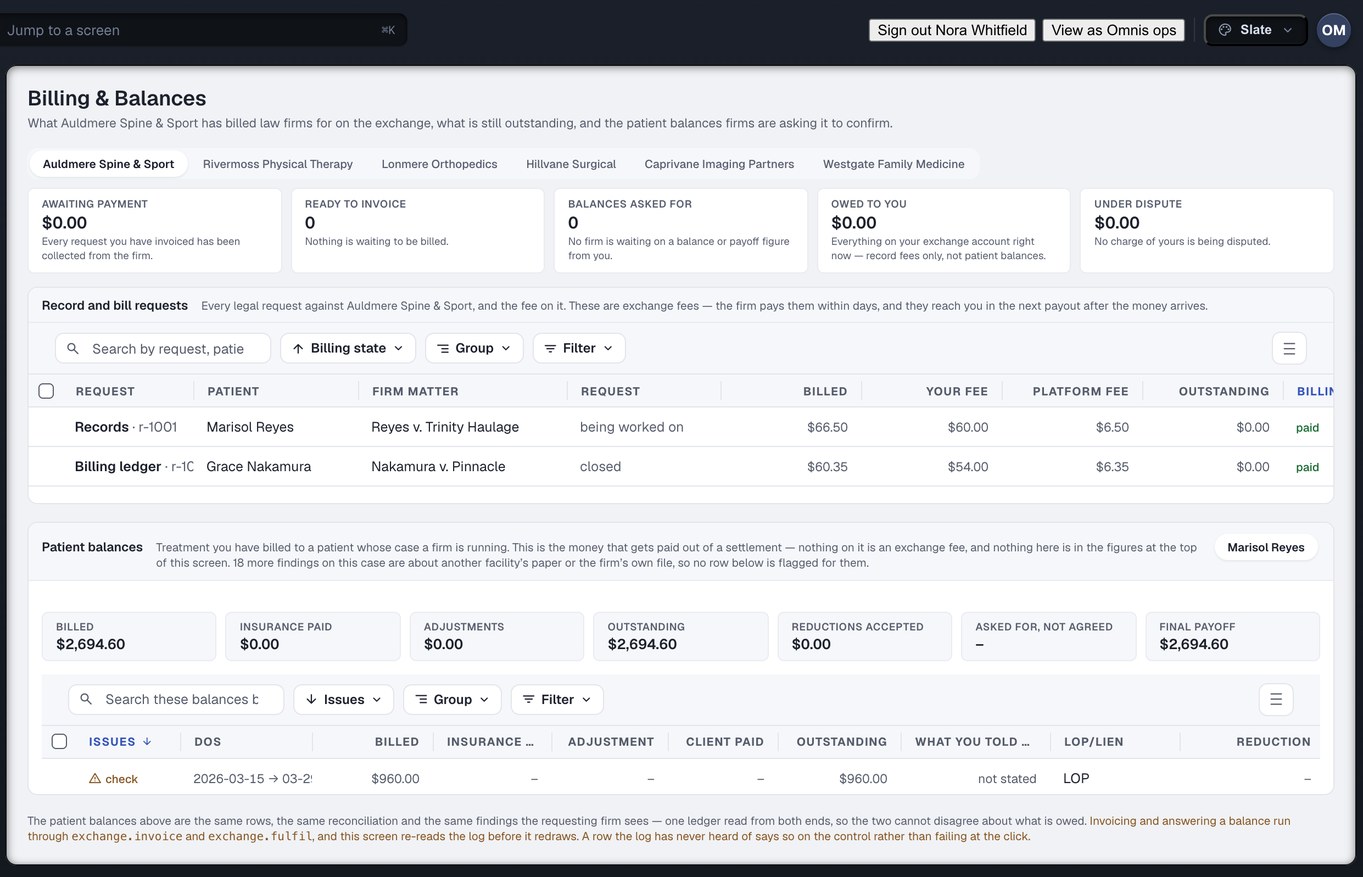
Billing & Balances, captured from the running build, 24 September 2026. Demonstration data — every name, matter and figure is a fixture, not a real client, clinic or balance.
Three conversations every billing desk has had, and lost
None of them is about whether you did the work. All of them are about whether there is a record of it that both sides accept.
The balance they question is one you cannot rebuild
The case closes. A paralegal you have never spoken to asks why the figure on the payoff letter is not the figure on the bill sent last spring. Between the two sit an insurance payment, a contractual write-off and a copay, posted by three people in two systems, and nobody wrote down which was which.
A reduction lands as a number with no reasoning
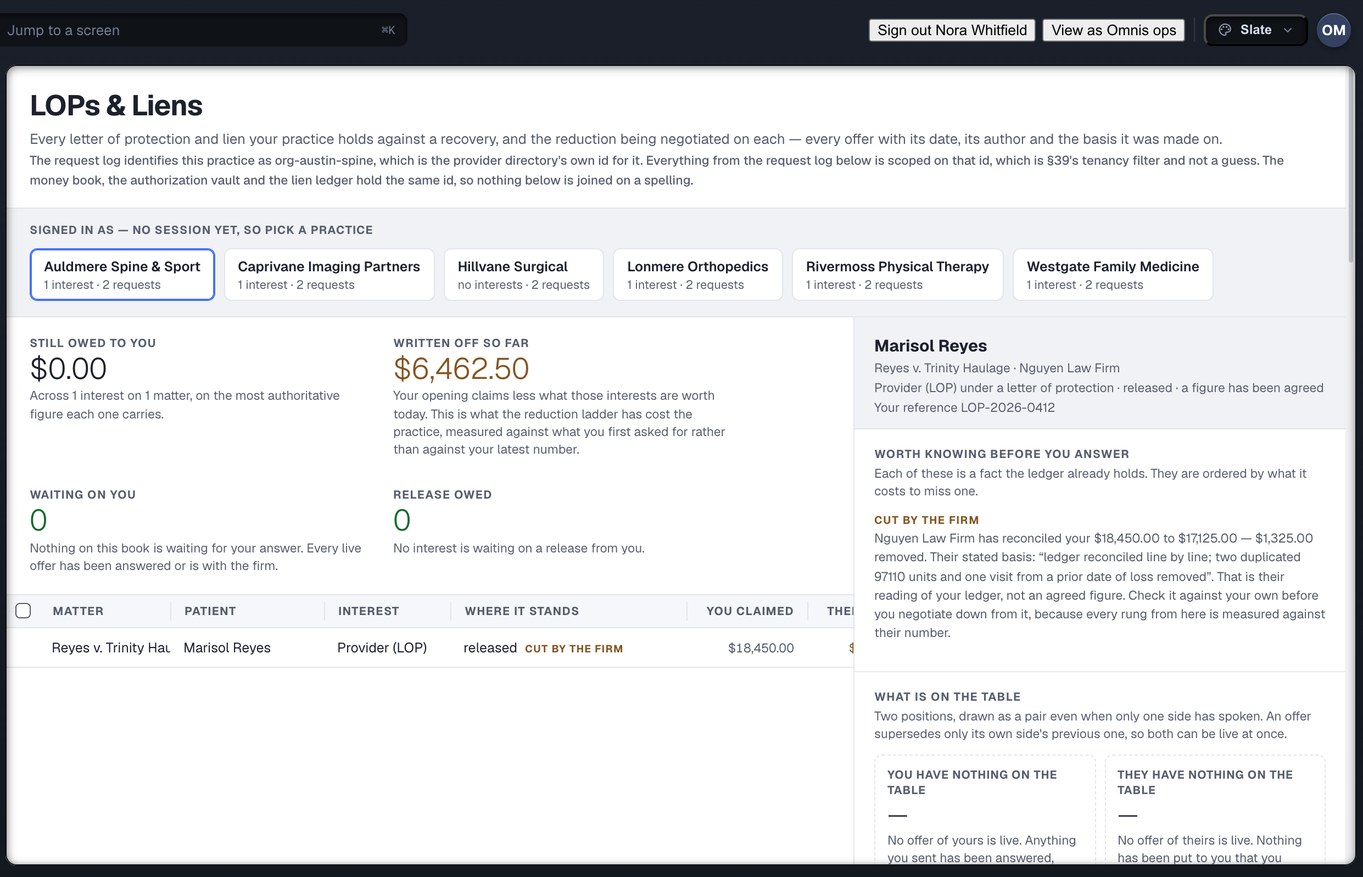
The firm says it will pay $17,125.00 on your $18,450.00. Not why. The only durable record of how the two figures relate is a PDF in an email thread, and the person who ran that thread has left. You cannot tell whether they removed a duplicate line or simply asked for less.
The remittance is smaller than the statement
The firm paid $66.50 for a records request. $60.00 reached your account. The line that explains the difference says “adjustment” and nothing else, so somebody opens a ticket — every month, for every practice, until somebody prints the subtraction.
Eight mechanisms between a bill going out and a payout landing
Injury Docs is one system that the firm and the practice both open. Nothing on any money screen is a stored total — every figure is folded out of an append-only record of what actually happened, each time the screen draws. That is why the two sides cannot disagree about what is owed: there is only one derivation.
The firm reads your ledger, and its reasoning lands on it
Eleven columns per date of service: billed, insurance paid, adjustment, client paid, outstanding, the LOP or lien on it, the reduction, the final payoff and what has been paid. Each column is defined exactly once, and outstanding is never typed in — it is billed, less insurance paid, less adjustment, less client paid, less the reduction you accepted. When the firm reconciles a line, you see the amount removed and the basis they stated, in their words.
- Billed is your gross charge as your own itemised bill states it — never net of anything, never computed
- A bill that has not arrived is “not stated”, not zero — the line stays visible and a finding names it
- The firm’s reconciled figure is their reading of your ledger, labelled as such — not an agreed figure
What this means for you: when the balance is questioned, you and the firm are looking at the same rows. The argument, if there is one, is about a stated basis, not about whose spreadsheet is right.
An adjustment is not a reduction, and only one of them moves money
They look identical on a screen and they are different objects. An adjustment is a write-off you have already taken on your own books — the contractual PPO adjustment, a courtesy discount, a timely-filing write-off. A reduction is money you might agree to forgive out of the settlement, and it is a promise until you accept it. Injury Docs keeps them in separate columns, and a reduction that has only been requested or offered is carried and displayed but kept out of every total.
- The fact that an unaccepted reduction is excluded is itself shown as a finding, so nobody reads a number off the screen that is not in the sum
- The settlement disbursement is its own column, never folded into what the patient paid, so a check can never be counted twice
- Your ledger and the firm’s stay in agreement about what has been posted and what is still being negotiated
What this means for you: the firm cannot short-pay you at closeout against a reduction you never agreed to, because the product will not subtract it.
Balances and payoffs are tracked requests with a good-through date
A balance, a final balance and a payoff are three of the thirteen things a firm can ask you for, and each arrives as a request with a state, an owner and a clock — not as an email to a shared mailbox. You answer it from the ledger the firm is already reading. A payoff figure is recorded with its source and the date it is good through, as your letter states it. After that date the figure is flagged as expired on the firm’s side and on yours, with a sentence saying a fresh one is needed.
- “Balances asked for” is a count on your Billing & Balances screen, so nothing waits in an inbox unnoticed
- A firm disbursing against a payoff that has lapsed is told it is paying the old number
- The ledger’s own checks run on the same rows: duplicate bills, overlapping dates of service, a record with no bill, a bill with no record, and totals that disagree, each with a remedy
What this means for you: a payoff letter stops being a number somebody remembers and becomes a request with a date on it that both sides can see expire.
The letter of protection you hold, and the ladder beneath it
A reduction is a negotiation, and Injury Docs keeps it as one: every offer, every counter and every question, with who moved, when, to what number and on what stated basis. The outcome is computed from those rungs rather than typed in by whoever spoke to the firm last. Your opening figure and the firm’s reconciled figure are kept apart and labelled, and “written off so far” is measured against what you first asked for, not against your latest number.
- Two positions are always drawn as a pair — yours and theirs — even when only one side has spoken
- You cannot accept your own offer, and neither can they; a counter answers the other side
- A payoff cannot be issued while an offer is live on the ladder — the offer is accepted, declined or withdrawn first
What this means for you: every sentence on this screen is printed identically on the firm’s Liens screen. None of them assumes which chair the reader is in — the parties are named, and “you” only ever means whoever is attempting the act. The two sides cannot be told different stories about the same rule.
A charge under dispute is frozen, and the reason is on the banner
A firm can dispute a charge for one of ten reasons — wrong patient, incomplete fulfilment, missing pages, an incorrect fee, a duplicate request, a duplicate payment, unreadable media, the wrong date range, a disagreement over whether records exist, or a refund request. What the person actually wrote is shown to you word for word. Before a payout is cut, the disputed charge is held back with a sentence saying so; once a payout has been instructed, the whole batch freezes rather than arriving smaller than the statement you were shown.
- A freeze does not shrink the payout and is never clawed back afterwards — that is the failure this design exists to avoid
- Five resolutions: the charge stands, a refund, a credit to the firm, the charge voided, or escalated — and the freeze lifts only when one of the first four is recorded
- A firm’s payment bouncing at its bank does not touch what you are owed; you did the work and the record says so
What this means for you: you never discover a shortfall in a month you had already booked, over a dispute you did not know existed.
A payout cannot be for more than you are owed, or twice for one charge
Every payout instruction is checked against the accounts before it is written, and each refusal is a sentence rather than a greyed-out button. A payout larger than what you are owed in total — counting any batch already cut and on its way — is refused, because sending more than has been earned leaves you carrying a balance the next payout would silently eat. A charge already on another payout is refused, because paying for the same request on two batches pays you twice for one piece of work and both statements would add up on their own page.
- A refund or adjustment cannot be taken off twice: each one is claimed by the payout that deducted it
- A charge raised for another practice cannot be put on your batch, and neither can its disputes
- A payout the bank returned can be instructed again; one still on its way cannot be re-cut until it is resolved
What this means for you: the guard sits where the money is recorded, not on a screen — so an import, a batch job and a person at a keyboard are all refused by the same sentence.
The statement prints its own subtraction
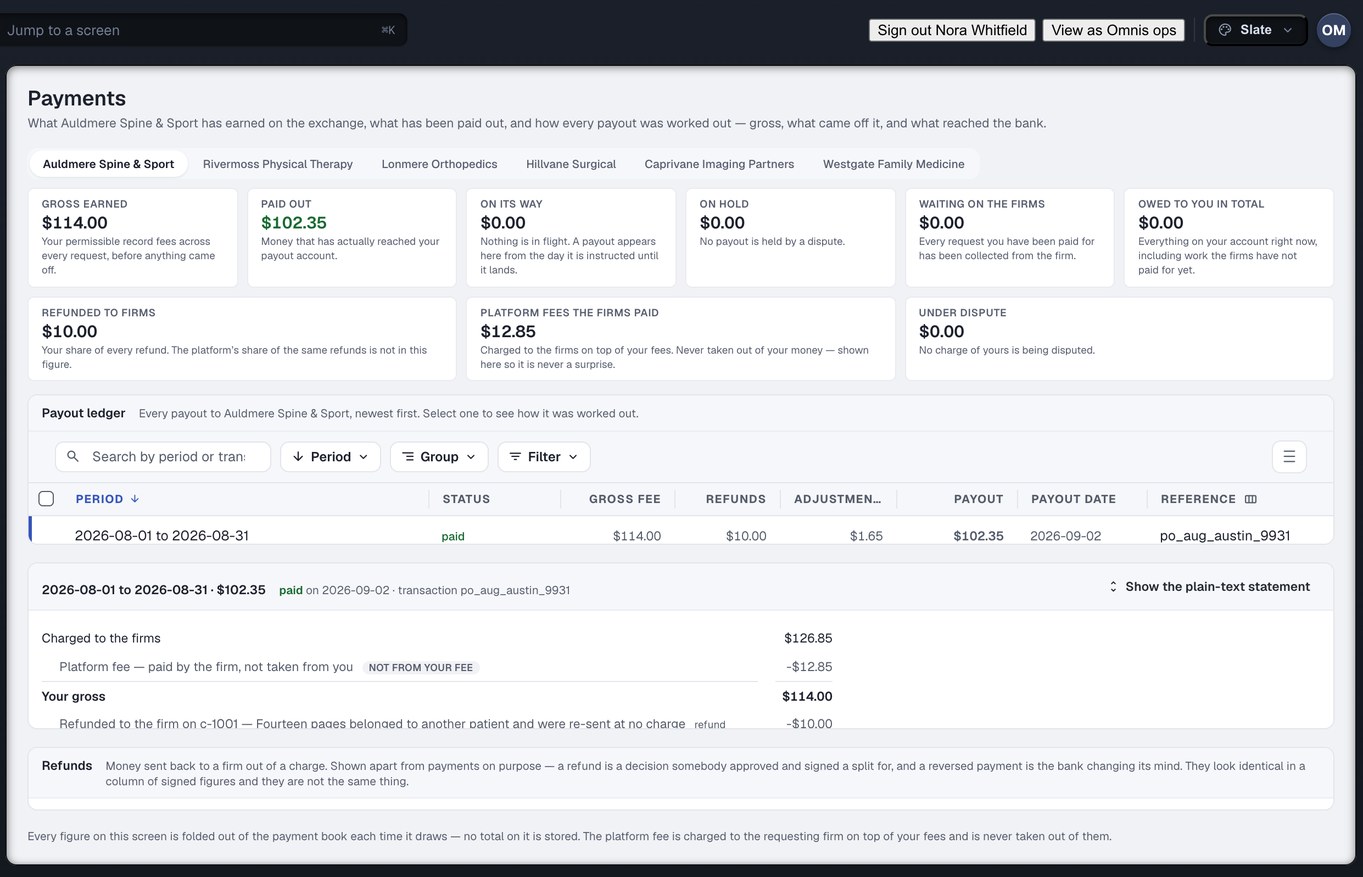
Three tiers, kept apart. What the firm was charged. The platform fee — paid by the firm on top of your permissible fee, shown above your gross and never among your deductions, because it was never your money. Your gross. Then each deduction as a line that names the charge it came from, and the net. At the bottom, the subtraction is written out as a sentence, because the person about to open a ticket is the person who just did that sum and got a different answer.
- Charges deliberately left off a period are listed with the reason, so nothing goes missing silently
- A refund is shown apart from a reversed payment — one is a decision somebody signed, the other is a bank changing its mind
- The statement is plain text as well as a screen, so the same figures go into an email or a printout unchanged
What this means for you: “the firm paid $66.50, why did I get $60.00” is answered on the statement itself, in one screen, without a call.
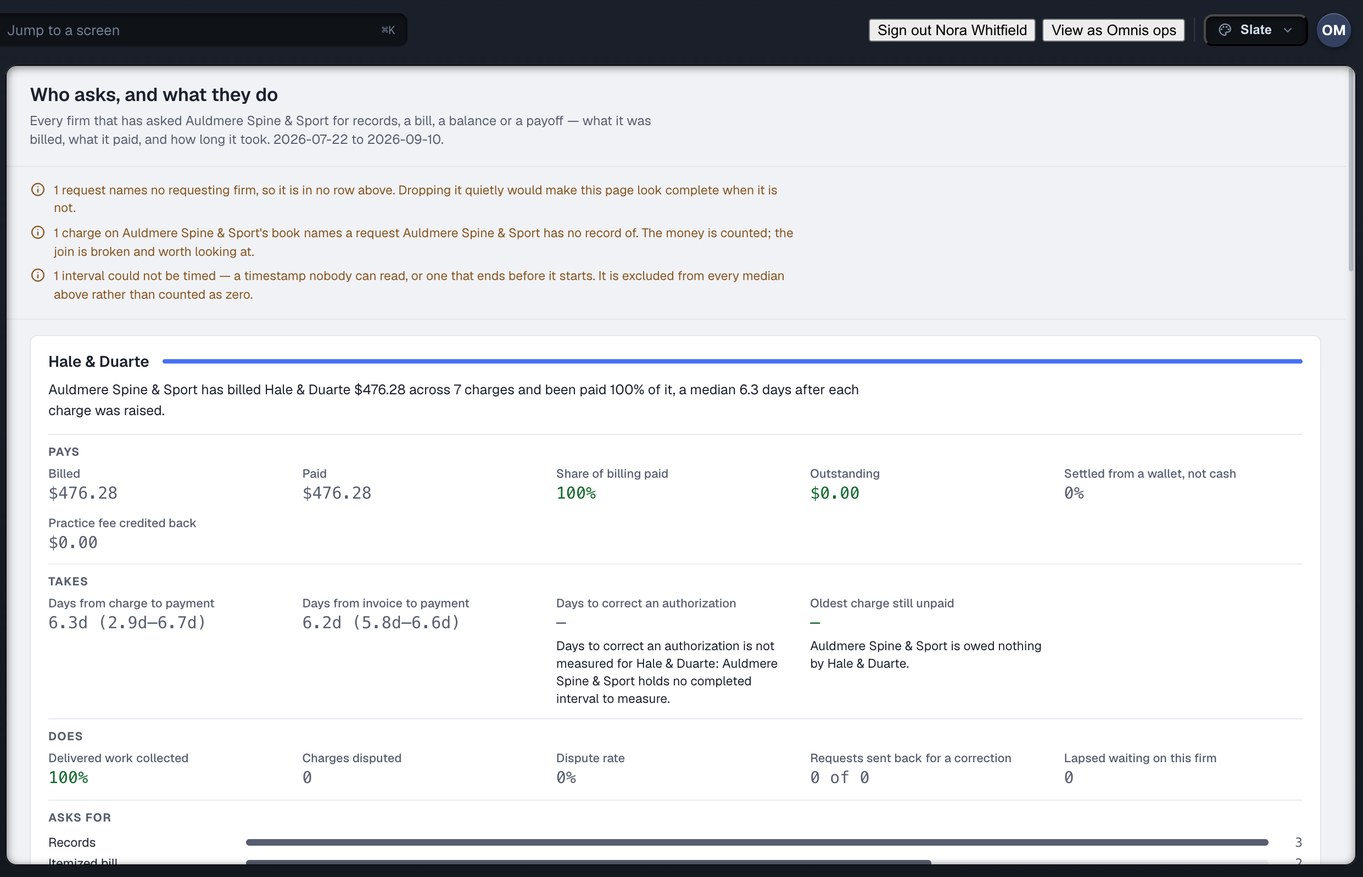
Who asks: what each firm was billed, what it paid, and how long it took
Every system in this industry tells a law firm which carriers pay and how fast. Nothing tells a practice which law firms do. Who asks is that question from your chair: for every firm that has asked you for records, a bill, a balance or a payoff — what it was billed, what it paid, what is outstanding, the oldest charge still unpaid, days from charge to payment, days from invoice to payment, charges disputed, and requests that lapsed waiting on the firm.
- Totals are always shown; a rate or a median is withheld below three observations rather than printed as a percentage with nothing behind it
- A firm’s card failing is not an event about your practice, so it is never scored against a firm at your scale
- Rows it could not place — a request naming no firm, an interval that could not be timed — are listed at the top, never dropped
What this means for you: your standing is explained, not scored — and so is theirs. No firm is called a slow payer. Every sentence names both parties, states what was billed, paid and how long it took, and could be forwarded to the firm it describes without editing.
Nothing here talks to a bank
The money engine decides and records. It does not send a wire, run a card or build an ACH file, and it never will. A payment, a payout, a decline, a return — each arrives as a fact somebody else’s processor reported, with its reference, and the screen is folded out of those facts. That is what lets the same arithmetic run on your desk, in a monthly statement, and in a replay of last March’s book, and give the same answer in all three.
What this means for you: when your bank says one thing and the screen says another, there is a record of what was believed to be true at the time, and a reference to take to the processor.
Counted from the build, not from a case study
Facts about what exists — not claims about what it will collect for you. We have no practice outcome figures, and we will not print a guess.
Four screens about getting paid for work already done
The practice rail has twelve destinations. These are the four your desk lives on. Each one folds its figures out of the same record every time it draws — no screen holds a total the others could disagree with.
Billing & Balances
What you have billed law firms for on the exchange, what is still outstanding, and the patient balances firms are asking you to confirm.
LOPs & Liens
Every letter of protection and lien your practice holds against a recovery, and the reduction being negotiated on each — every offer with its date, its author and the basis it was made on.
Payments
What you have earned on the exchange, what has been paid out, and how every payout was worked out — gross, what came off it, and what reached the bank.
Who asks
Every firm that has asked your practice for records, a bill, a balance or a payoff — what it was billed, what it paid, and how long it took, over a stated window.
And the parts of the desk your billing work touches
Settings — fees and payout account
Your fee schedule is configuration, not a default: every rate is reviewed by a named person on a named date, and a jurisdiction with nothing configured produces “cannot be priced” rather than a number. A component your rule does not offer is unpriceable, not free.
Exceptions
Your blocked rows and what would unblock each one — a balance request waiting on you, a bill the firm says it never received, a payoff that has lapsed. Each names the remedy and whose desk it is on.
Records, read from the firm’s side
The firm sees one reading per matter and practice on three tracks — records, bills, affidavit — because the chart comes from records and the ledger from billing, often weeks apart. A bill ask is its own leg, so “we have the chart” never hides “we do not have the bill”.
A refusal is a sentence, and both sides read the same one
The rules that protect your balance live where the money is recorded, so they cannot be walked around by a different screen, a batch job or an import. When one of them says no, it says what is missing and whose job that is.
The settlement rail runs in eight rungs — a figure agreed, approved, the firm’s money held, a payment instructed, paid, confirmed by you, released, closed — and two orderings carry the design. No payment is instructed until the firm’s settlement money has actually arrived and is held for you. No release is recorded until you have confirmed the money is in your account.
Create your practice accountFour things this deliberately is not
Each of these is a real product somewhere — one of them is ours. Being clear about the edges is how you can trust the middle.
Not practice billing software
Injury Docs does not code encounters, build superbills or file claims. Your gross charge arrives here as the number on your own itemised bill. Charge capture, coding and clinical documentation are CarePro, a different Omnis product.
Not a bank, and not a payment processor
Nothing here sends a wire or runs a card. The money engine decides what should happen and records what a processor reported did happen, with its reference. The two are kept apart on purpose, so there is always a record of what was believed to be true at the time.
Not a collections agency
Nothing here chases a firm on your behalf, and no measure pretends to. What you get is a sentence per firm stating what was billed, what was paid and how long it took — one you can forward into your own collections email without editing, because it names both parties and characterises neither.
Not a scoreboard of firms
No firm is labelled. A rate that rests on two charges is withheld, not softened. A measure the data cannot support — how often a firm pays without being chased, an average reduction it accepts — is listed as not computed, with the reason, rather than estimated.
The six that come up first
A firm has asked for a final balance. What do we answer from?
From the same patient-balance rows the firm is already reading — billed, insurance paid, adjustment, client paid, the reduction you accepted, and the outstanding figure derived from them. The request sits in “balances asked for” on your Billing & Balances screen with its clock, and your answer is recorded with its source and the date it is good through.
Can the firm subtract a reduction we have not agreed to?
No. A reduction has a status, and only an accepted one is allowed to move a balance. A requested or offered reduction is carried and displayed and kept out of every total, and the screen says so with a finding rather than leaving you to notice. The firm’s reconciled figure is labelled as their reading of your ledger, not as an agreed number.
The firm paid $66.50 for a records request. Why did $60.00 reach us?
Because $6.50 of it was the platform fee, which the firm paid on top of your permissible fee. It was never your money, so it is shown above your gross on the statement and never among your deductions. Any line that does come off your gross — a refund, a processing fee, a correction — names the charge it came from, and the subtraction is printed under it.
What happens to our payout when a firm disputes one charge?
If the payout has not been cut yet, that one charge is held back with a sentence saying it is on hold while the request is disputed, and the rest goes on the statement. If the payout has already been instructed, the whole batch holds — it does not arrive smaller than the figure you were shown, and it is never clawed back afterwards. The reason the firm gave is on the banner, in their words.
Can a firm see what Who asks says about it?
Every sentence on that screen is written so that it could be. The parties are named, nothing addresses a reader as “you”, and nothing characterises a firm — it states what was billed, what was paid and how long it took, with the sample beside it. A firm reading its own row should be able to disagree with the arithmetic and nothing else.
Does this move money, or connect to our bank?
No. The money engine decides and records; it does not talk to a processor, a card network or a bank, and it is designed never to. A payment or a payout is recorded as a fact with the processor’s own reference, which is what you take to their dashboard if your bank statement and this screen ever disagree.
Bring the balance that was questioned last spring.
Create your practice account and put one matter’s ledger, its letter of protection and its reduction through the same screens the firm reads — and see what a stated basis looks like next to a number.
The whole practice desk: Injury Docs for medical providers → · The firm’s side of the same ledger: Bills & Balances → · Liens & Reductions →