You are not the clinic. You are still an account.
A practice can delegate its release-of-information to you. A request delivered to that practice is then workable by your organisation under a grant scoped to that one request, with an expiry somebody typed — and you see that request and nothing else the practice owns. The affidavit is sworn by you, and when one comes back wrong, what is wrong with it is written down.
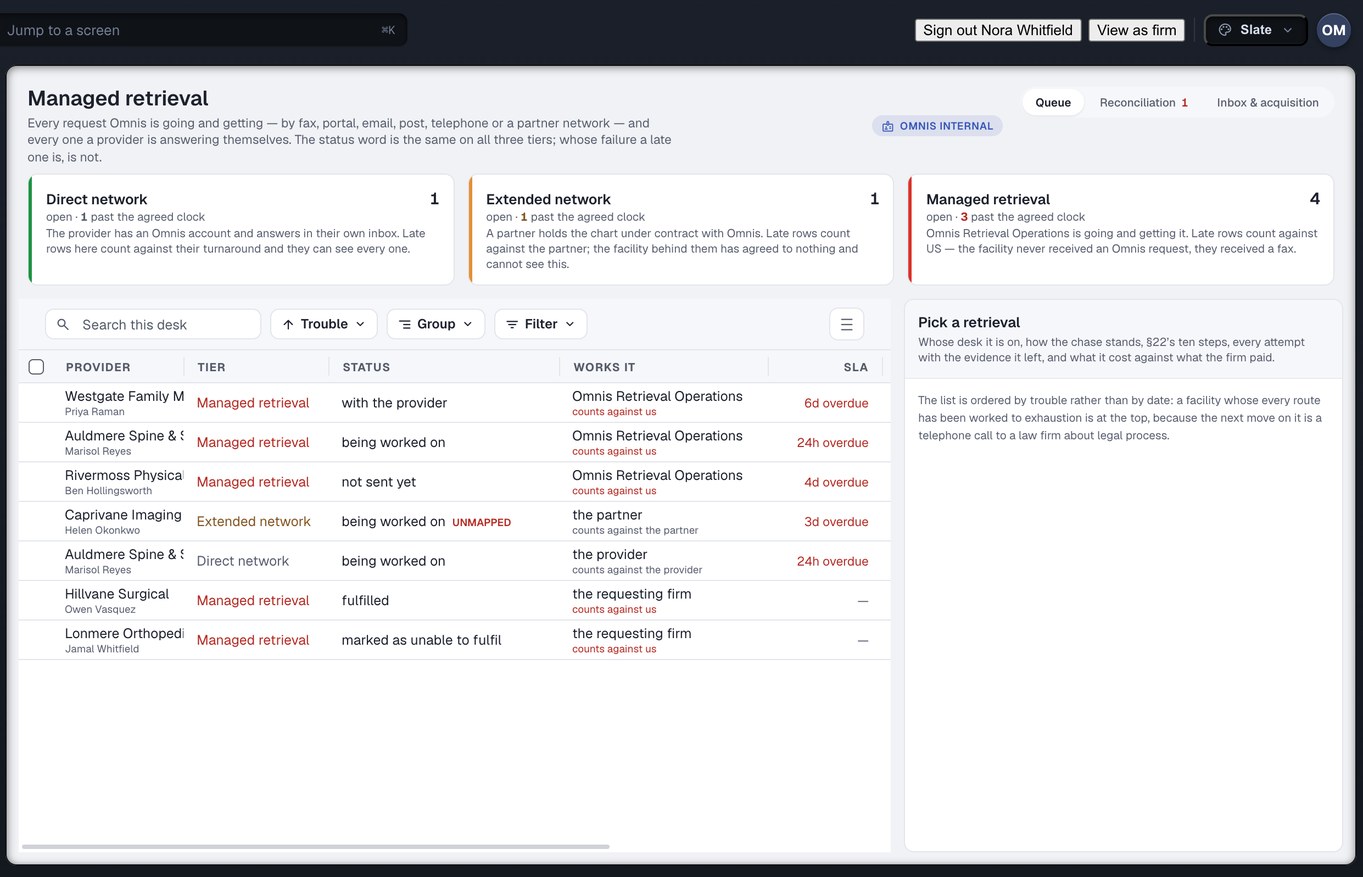
Omnis’s own managed-retrieval desk — an Omnis-internal screen, shown so you can see how a chase is tracked. Captured from the running build, 24 September 2026. Demonstration data — every name, matter and figure is a fixture, not a real client, clinic or balance.
The systems firms use today have no word for you
A partner is everyone who touches a matter and is neither the law firm nor the treating clinic. Most portals model two parties. You are the third, and it shows in three places.
You hold the chart. The request names somebody else.
The hospital outsourced release-of-information to you. The firm ordered from the hospital, paid your invoice, and now rings to ask why their request says one name and their cheque went to another. Nobody recorded that those are the same request, so nobody can answer.
Your access outlives the job
The usual way a practice lets a vendor in is a shared login. It looks exactly like an employee’s, it has no end date, and it still works three years after the contract ended. Nobody notices, because there is nothing to notice — the account is simply there.
A defective affidavit looks finished
One signed by the wrong person, missing pages or carrying the wrong dates is filed as received. It looks satisfied on the file and fails on objection, which is worse than never having asked — and by then the paralegal who noticed has no way to tell you what was wrong with it.
Eight mechanisms, four of them about the grant
Injury Docs is one system that the firm and the clinic both open. A partner reaches it through a grant the owner of the record issued. Everything below follows from that one shape.
A partner is an account, not a login somebody shares
Record custodian and ROI vendor are two of the seven partner roles, in the fourth of the product’s four organisation families. A partner role describes what your people may do inside your own shop — your own queue, your own staff list, your own invoices. It grants nothing whatsoever about a practice’s or a firm’s data, because a role is not how a partner gets that data.
- Your organisation has its own people, offices and roles, visible in a user list an administrator can read
- Somebody else’s records arrive only as a delegation, issued by whoever owns them, and it expires
- No partner role, without exception, has a seat where providers are ranked and firms choose
What this means for you: revoking your access is a thing that can actually happen, because you never held it as an employee would.
One request, held by your organisation, with an expiry
The grant a delivered request carries is scoped to that one request by its number. It is held by your organisation rather than by a person, so a clerk leaving does not take the access with them and a clerk joining does not need a new one. Its expiry is required — there is no version of the grant without one — and it must name its verbs and its object kinds. A grant that permitted every verb on every kind would not be a grant; it would be an account.
- Seven verbs: read, list, update, send, download, approve and reject. Not pay, and not negotiate — the firm decides what to pay
- Two object kinds: the request and its documents. Nothing else the practice owns is reachable
- The practice keeps seeing everything it saw before. A delegation adds a grant to you and takes nothing from them
What this means for you: you can tell a practice exactly what you will and will not be able to see, in one sentence, before they agree.
The grant rides inside the delivery
The obvious design is two records — “delivered”, then “access granted” — and it was rejected for a measured reason: a write that commits the first and loses the second leaves a delivery on the record that granted nobody anything, which is a request the recipient cannot open. So the grant is a required part of the delivery itself. A delivery that does not grant is not a thing that can be written down.
- The grant’s identity is derived from the request, so re-reading the record produces the same grant it was written with
- Who issued it, and when, is on the record. Nothing is attributed to “system”
- Access is re-read from the record on every act rather than cached, because a cached permission is a revocation that has not taken effect
What this means for you: there is no state in which a request has reached you and you cannot open it.
The affidavit is sworn by you, and a defect is named
A business-records affidavit is what lets the records it covers stand on their own without calling the custodian to the stand. It is sworn by the custodian and addressed to somebody, and its standing is not a yes or no. Four answers: nobody has one yet and nothing is wrong; one arrived and will not do; none is coming from this request; or it is on file. Only the middle two are a problem, and only those raise a flag.
- “Defective” is its own state, with the defect written on it. A defect nobody wrote down cannot be corrected, so an unreasoned one puts the next act back on the firm
- “Corrected” is distinct from “fulfilled”. The defective first one stays in the log and must never be the copy attached to a demand
- Past two defects on the same affidavit, the sentence on the row says so: a subpoena to the custodian is usually faster than a third correction
What this means for you: a correction is a reading exercise — what is wrong, what would fix it, and whose act is next — not a phone call reconstructing it.
Off the exchange, the status word does not change
Sometimes the clinic is on Injury Docs and answers in its own inbox. Sometimes a partner like you holds the chart under contract with Omnis. Sometimes nobody holds anything electronic and Omnis’s own retrieval desk chases a county hospital by fax, portal, email, post or telephone. Three different mechanics — direct network, extended network, managed retrieval — and the firm reads one set of 21 request states on all of them. They are tiers of how the work gets done, never of how good the provider is.
- Whose failure a late row is, is recorded: the provider on a direct row, the partner on an extended one, Omnis on a managed one
- The facility behind an extended row agreed to nothing and cannot see it. It is never the party the firm is entitled to hold to the clock
- Every attempt on a managed retrieval is logged with the evidence it left and what it cost, against what the firm paid
What this means for you: a firm never learns a second vocabulary to read a row you are working, and a hospital is never scored on the performance of somebody else’s fax line.
Posting a letter is not delivering a request
Each channel leaves a different kind of evidence, and only some of it proves arrival. A fax transmission report reading ok, a portal confirmation code, a signed certified-mail card, a person reached on the telephone, a partner’s acknowledgement — those move the request to “with the provider”. An envelope in a postbox and an email a relay accepted prove effort, not arrival, and the row stays honest at “not sent yet” until somebody at the far end acknowledges it.
- Every channel has a budget and a wait: four faxes a day apart, two portal submissions two days apart, three emails two days apart, five telephone calls a day apart, two partner orders a day apart
- Post gets one attempt and a fourteen-day wait, because a second envelope to an address that swallowed the first is a fortnight spent to learn nothing
- A failed fax is still an attempt. A counter that only counts successes lets a task sit forever
What this means for you: when a firm asks whether the hospital ever received the request, the answer is a transmission report or an honest “we posted it on the 3rd and have no confirmation” — never the same green tick for both.
The chase ladder names when a route is exhausted
The chase climbs on attempts spent against a silent facility, not on elapsed time. Five rungs: the assigned agent works the channel on its own cadence; a retrieval supervisor picks a new route once the budget is spent; the desk stops faxing the records line and telephones a person with authority; network operations corrects an endpoint that turned out to be wrong; and finally the firm is told, because the answer may now be a subpoena rather than a request.
- Six named endings for a task nobody could fulfil: no records exist, wrong facility, a requirement the firm never met, every channel exhausted, the provider refused, the partner declined
- A task cannot be closed as unfulfillable while attempts remain. The refusal is a sentence naming the facility, the attempts made and the budget, and what to try next
- A dead endpoint is corrected in the provider graph before anyone tries again — the same bad number is costing every firm
What this means for you: “the hospital has not responded” is never the end of the story on a managed retrieval. Going and getting it is the product the firm bought.
What you said is kept beside what it means
When a vendor reports a status in its own words, the raw code — not trimmed, not tidied — survives on the record, with your order number, and the plain-English state sits beside it. A code nobody has taught the product moves nothing: the request keeps the state it had, its clock keeps running, and the code goes into a queue for somebody to teach. Your turnaround is measured from what happened on the record against the request’s agreed clock, not from a figure you report about yourself.
- A fault in the connection — unreachable, rejected credentials, an answer nobody could parse — is never folded into the request’s state. It is Omnis’s desk, and it never reads as a provider being slow
- The typical turnaround you state appears in the firm’s search as your own figure. What a late row is judged against is the request’s clock
- The list of facilities you can reach carries the date you last confirmed it. Older than ninety days, it stops routing to you and the request falls back to managed retrieval
What this means for you: when a firm says your portal shows one thing and their screen another, both are on the record and somebody can show they are the same request.
Counted from the build, not from a case study
Facts about what exists, counted on 24 September 2026 — not claims about what it will earn you. We have no partner outcome figures, and we will not print a guess.
You work under the practice’s screens, and Omnis works its own
A partner has no rail of its own. That is a fact about the product today, not a slogan. A delegated request is worked under the practice’s Records and Exceptions screens, on the one row the grant reaches; the chase of an off-network facility happens on Omnis’s desk, which you saw above.
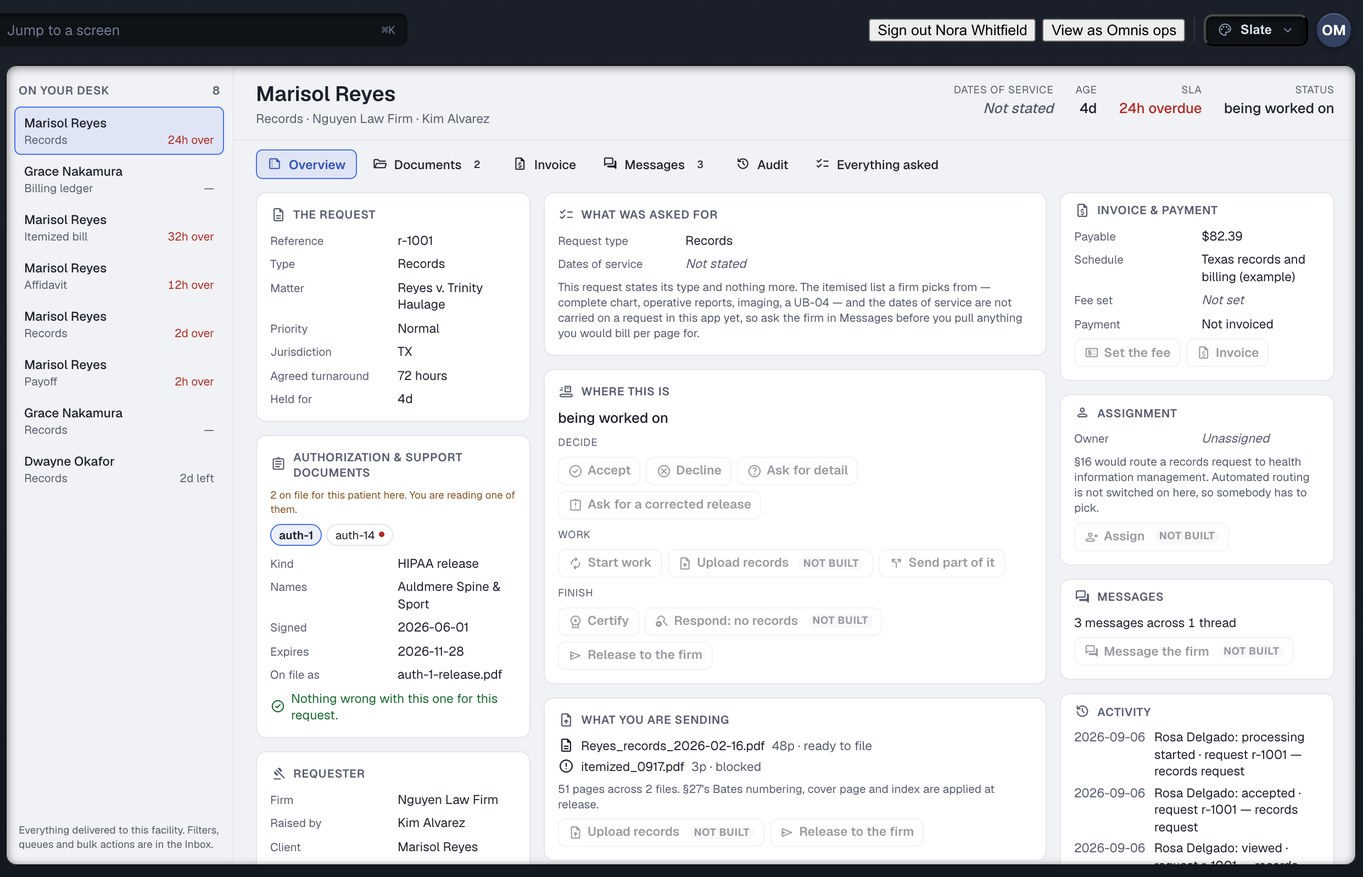
The practice’s Records screen — the screen a delegated custodian works a request under. Captured from the running build, 24 September 2026. Demonstration data — every name, matter and figure is a fixture, not a real client, clinic or balance.
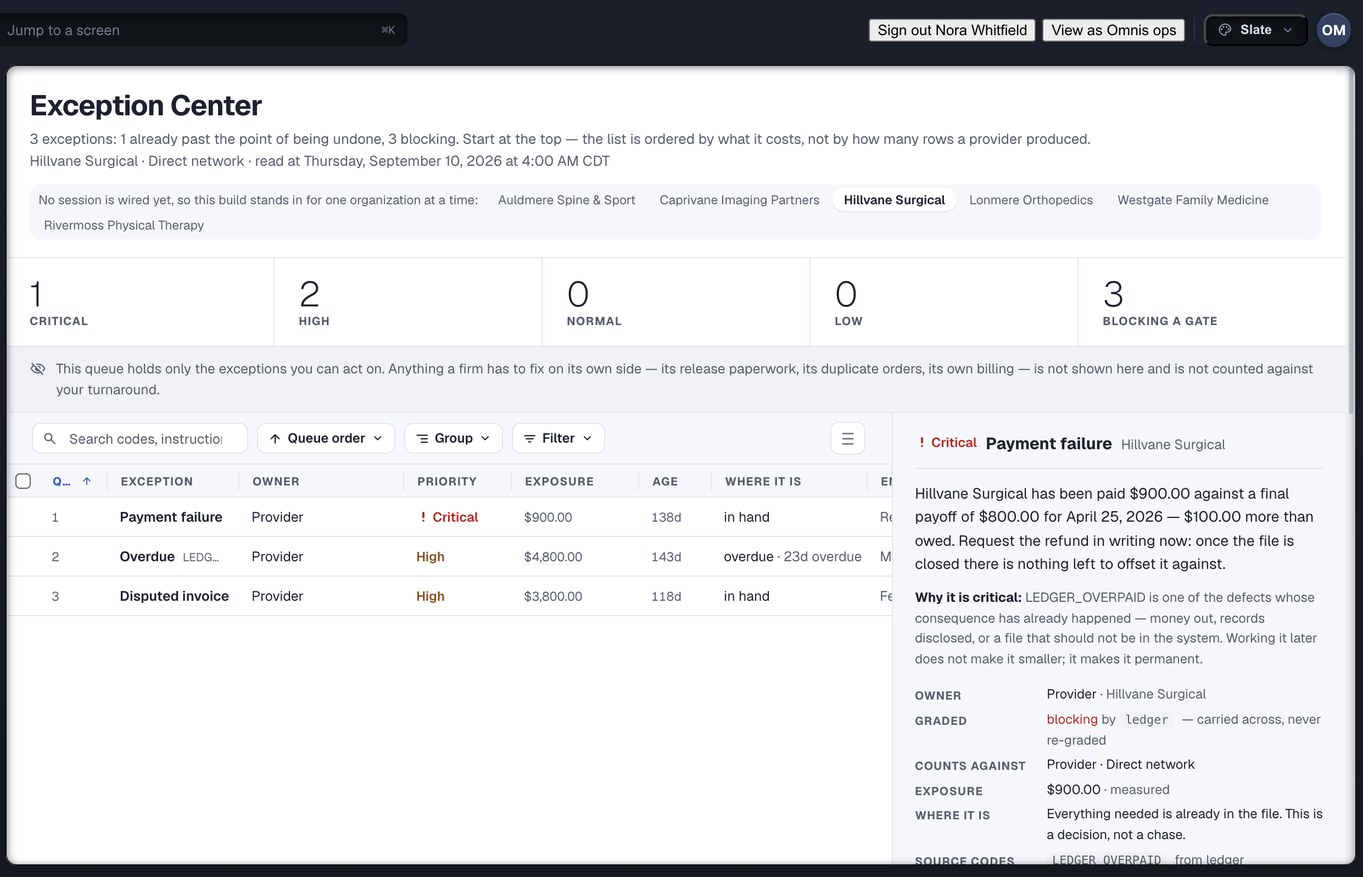
The practice’s Exception Center — the practice’s blocked rows, which a delegated custodian sees only for the request the grant names. Captured from the running build, 24 September 2026. Demonstration data — every name, matter and figure is a fixture, not a real client, clinic or balance.
What each of the two roles reaches
Record custodian
Holds and certifies records for practices that have delegated to you.
ROI vendor
Fulfils records on behalf of practices that have delegated specific requests.
Omnis’s retrieval desk
Not yours. Shown so you can see how a chase is tracked when a facility is not on the exchange.
The other partner accounts
Two more partner roles exist as accounts today and are worth naming honestly. An interpreter takes interpretation assignments on named appointments; a transportation provider takes transport assignments on named appointments. Each reaches referrals in its own shop and nothing else, with amounts for its own invoices, and neither has a rail of its own — the same fact that is true of you. Referrals from a firm to a clinic are a tracked object in the product; the assignment of an interpreter or a driver to one is modelled as an account, and that is all this page will claim for it.
Six things this deliberately is not
Being clear about the edges is how you can trust the middle. Three of these are choices; three are simply where the build stands on 24 September 2026.
Not your ROI software
Injury Docs is the exchange between the firm and the clinic. It does not scan, OCR or ship paper for you, it does not run your production floor, and it does not replace whatever you use to do those things. What it changes is that a request reaching you has a state, an owner, a clock and a record of what you sent.
A grant cannot be handed onward
Only the owner of a record can delegate it, and a grant names exactly one owner. On a firm’s request that means the firm delegates to you directly; a clinic that outsources to you cannot pass its own grant along. We have written down that this may be operationally awkward, because the clinic picks its vendor and the firm may never have heard of them. It is the consequence of the rule, and the rule is that the firm controls who touches its client’s records.
No inbound fax number or intake gateway yet
The design for one exists: anything that arrives by fax or forwarded email becomes a draft, each field carries whether a model read it or a person typed it, and nothing a model read is promoted without a named human confirming it. None of that is wired to a line you can dial. If you have been told otherwise, you have been told wrong.
No live connection to any vendor’s system
The partner-network channel — its budget, its wait, its evidence, the table that turns your status codes into the firm’s states — is built and tested against a stand-in, not against anybody’s real system. Your first integration would be exactly that: a first.
Not a seat at the table where providers are ranked
A vendor acting for a practice must never be able to act as them where firms choose a provider: publish a listing, accept a referral, move a ranking. That is the practice’s commercial identity. No partner role holds it, and no delegation can carry it, so there is no route to it by either road.
What exists today, plainly
A desktop build with a local, append-only, hash-chained record. Every screen on this page renders from it and the write path works locally. Nothing here describes a server, a mobile app or a hosted service, because none exists.
The six that come up first
How do we get access to a practice’s requests?
The owner of the request issues a delegation to your organisation. Because a firm raises the request, the firm is the one that delegates it — the practice cannot hand its own grant onward. The delegation names the request, the seven verbs, the two object kinds and an expiry, and who issued it is on the record.
What do we see once we have it?
That request and its documents. Not the practice’s other requests, not its patients list, not its billing, not its liens. The practice keeps seeing everything it saw before; nothing was transferred to you, because visibility was never taken from them.
Can we invoice the firm?
An ROI vendor’s own invoices are money inside its own shop, exact to the cent. When your invoice arrives on a retrieval, it is captured as you sent it — your number, your basis in your words, the payee as stated — and it is never turned into a fee schedule nobody signed. The grant on a delivered request does not carry pay or negotiate: you fulfil and invoice, the firm decides what to pay.
What happens when an affidavit we swore comes back defective?
The request moves to a state called defective with the defect written on it, and the next act is yours. A replacement sworn by the custodian moves it to corrected — a distinct state, so the file keeps knowing there were two, and the first is never the one attached to a demand. If the firm reported a defect without saying what it was, the next act is theirs, not yours: you cannot correct what nobody named.
If a facility we cover goes quiet, whose failure is it?
Yours, on the record, if you hold the chart under contract — and the facility behind you is never the party the firm holds to the clock, because it agreed to nothing. On a managed retrieval it is Omnis’s. On a direct request it is the provider’s. Who works it and who the firm may hold to it are two separate fields, and they are routinely different.
Do we get screens of our own?
Not today. The product has 26 routed destinations across three audiences — 14 for the firm, 12 for the practice, 3 for Omnis’s own desk — and none is a partner rail. A delegated request is worked under the practice’s screens on the one row the grant reaches. We would rather you read that here than discover it on a call.
Bring the request the hospital says it never received.
Tell us which practices you hold records for and how a request reaches you today. We will show you the grant, the affidavit states and the chase on the record — and tell you plainly which parts are built and which are not.
Are you a clinic? Read the provider side → · A law firm? Read the firm side →