The case settled at two o’clock. Now six providers have to agree on a number.
One ledger the clinic reads too. Final balances and payoffs as tracked requests, each with a clock and a good-through date. A closeout list that says what still stops disbursement and whose desk it is on. And a settlement rail that will not record a release against money nobody confirmed. Nothing is paid through Injury Docs — it records the instruction, the confirmation and the release. The money moves in the bank.
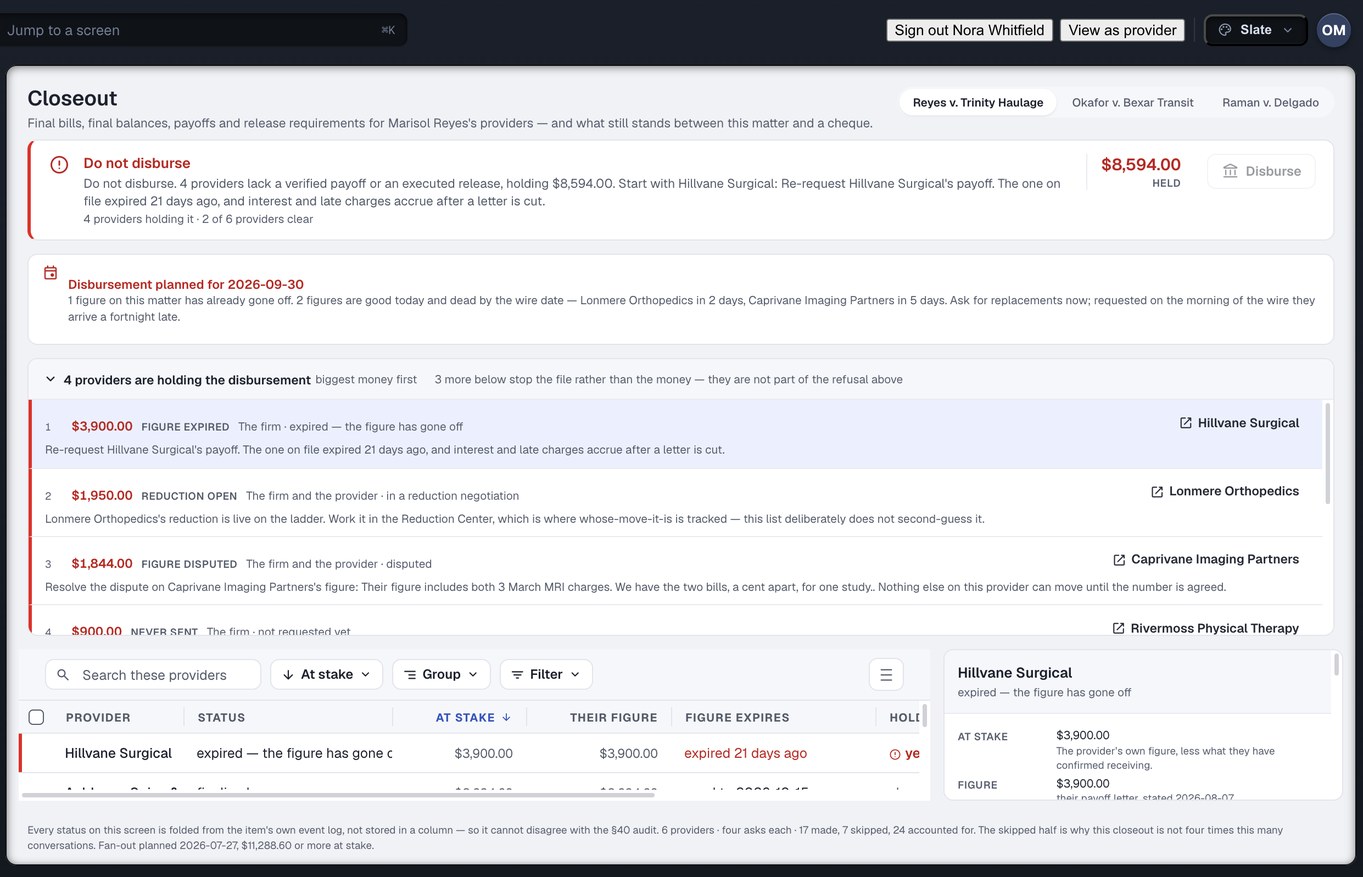
Closeout screen, captured from the running build, 24 September 2026. Demonstration data — every name, matter and figure is a fixture, not a real client, clinic or balance.
Disbursement waits on the last provider anybody remembered to chase
A settlement is one event, in one system, on one afternoon. What it starts is a dozen conversations about money, and today every one of them is an email thread with no status, no owner and no clock.
Six conversations, and nobody owns the sixth
Every provider on the file has to produce a final bill, a final balance, a payoff figure and a statement of what they need before they will sign a release. The disbursement does not wait on the slowest of them. It waits on the one nobody remembered to ask — and the screen was green the whole time, because nothing on it knew the ask never left.
The payoff was good through a date nobody wrote down
A payoff letter is good through a date. Wire after it and interest and late charges have been accruing since the letter was cut. The replacement gets requested on the morning of the wire and arrives a fortnight late, and the client asks why the money is still in trust.
Three documents disagree, after the release is signed
The provider’s ledger says one number, the paralegal’s spreadsheet another, and the closing statement was typed from a call note. Whoever finds the gap finds it after the release, when there is no settlement money left to fix it with — and the person who finds it is usually the provider whose cheque was short.
Eight mechanisms, built for the two desks that close a file
The settlement desk negotiates and builds the disbursement. The accounting desk moves the money. Both read one ledger, and so does the clinic.
One ledger, per provider, and the clinic reads it too
Billed, insurance paid, adjustment, client paid, accepted reduction, outstanding — per provider, per date of service. Outstanding is never stored. It is computed from the stated columns every time the screen draws: billed, less what insurance paid, less the adjustment the provider already took, less what the client paid out of pocket, less the reduction the provider actually accepted. A reduction that has only been asked for or offered is carried on screen and kept out of every total, and the exclusion is itself flagged, so nobody reads a number off the screen that is not in the sum.
- An adjustment is a write-off the provider already posted; a reduction is a promise conditional on the case closing. They are separate columns because collapsing them is how a provider gets short-paid at closeout
- A line whose itemised bill has not arrived is unknown, not zero — so every total on an incomplete ledger is labelled a floor
- The clinic sees the same derivation, not a copy, with the reason you stated beside every reconciled figure, word for word
What this means for you: a balance dispute at closeout is a reading exercise, not a reconstruction from three documents.
Four asks per provider, each with a clock and a good-through date
When the case settles, the closeout opens one item per provider and plans four asks: the final itemised bill, the final balance, the payoff letter and the release requirements. Four rather than one “closeout packet”, because three of them can finish while the fourth is argued about, and because on the clinic’s side a records clerk, a billing clerk and an A/R clerk are three different queues. Each ask is an ordinary tracked request with its own clock — by default 120 hours for the final bill, 72 for the final balance, 48 for the payoff and 24 for the release requirements.
- A payoff figure carries the date the letter says it is good through. A letter that states none is treated as good for 30 days from the day it was written, by default
- The closeout asks for a replacement seven days before a figure dies, so the new letter arrives before the old one is needed
- An item reads Requested only when an ask actually left as a request. A plan is not a send
What this means for you: you never wait on a provider who was never contacted, and you never find out on the morning of the wire that the payoff is dead.
The blockers list: what stops disbursement, and whose desk it is on
“Can we disburse?” is true roughly one day in thirty. The other twenty-nine, the useful answer is which provider, how much is behind them, whose move it is and what the call is. So the gate is not a button that goes grey. It is a ranked list — biggest money first, unknown amounts above all — with one hold per provider, and each hold is a sentence that says what to do next and whether it is the firm’s move, the provider’s, or both.
- Nine reasons an item can hold: the ask never sent, waiting on the provider, a figure received but not agreed, disputed, a reduction still open, expired, good today but dead by the planned wire date, a figure from a phone call or an unchecked extraction, or finalised with no number on it
- A provider the settlement does not pay — no LOP, no lien — stays on the list for their final-balance letter without holding eight other cheques
- A finished matter reads settled, not open, so the gate has nothing left to enable and a second disbursement out of trust is not a button anybody can press
What this means for you: a gate that names its reasons cannot be overridden in general. It can only be answered one reason at a time, which is the same thing as doing the work.
The settlement rail, and the three guards where money goes missing
Eight rungs, in order: amount agreed, approved, the firm’s money received, payment sent, paid, confirmed by the provider, released, closed. Three guards matter most. A payment cannot be instructed until the money it draws on has been recorded as received. A payment is checked against the agreed figure and not only against what arrived, so a transfer with an extra zero in it cannot become sendable settlement money. And a release cannot be recorded until the provider has confirmed the money reached them — because a lien release taken against an unconfirmed payment is a claim given up for nothing, and there is no undo.
- A confirmation cannot be recorded when nothing has been paid out. The guard sits on the event that grants permission, not only on the one that spends it
- A settlement cannot be cancelled once money has reached the provider. What comes back is a refund, recorded as one, so it shows on the firm’s invoice and on the provider’s statement
- Every rung names who moves next, in a sentence both desks can read — not a status chip that says INSTRUCTED and leaves you to work out whether that is good
What this means for you: the sequence a settlement clerk knows by heart is enforced by the record, not remembered by the person.
The stated basis survives into the closing statement
Every offer on the reduction ladder carries the basis it was made on, and the product refuses an offer with an empty one. “$17,500” is not a negotiating position; “$17,500, being the balance less what the health plan already paid and a share of the cost of recovery” is — it can be argued with, repeated by a colleague who was not on the call, and shown to a client asking why the hospital got that much. When the ladder closes, the agreed amount carries its basis with it, and the closing statement’s lien line carries that basis in words, with how sure the number is: a payoff letter, an agreed reduction, a figure checked against a named source, or the claimant’s say-so.
- Net to client is computed in a fixed order: gross, the attorney fee on the basis the fee agreement states, the costs the client bears, then each lien at its current best figure
- When the liens exceed the recovery, the statement says so and by how much, rather than printing a negative in a cell nobody scrolls to or a zero that looks plausible
- When an interest has no number yet, the statement refuses a net figure rather than printing a total with a federal interest missing from it
What this means for you: the sheet you hand the client cites the reason for every lien line, and the reason was written down on the day the number was agreed.
Money is whole cents, and the screen never rounds
Every amount is an integer number of cents. A ledger’s only job is that the columns agree, and a cent of drift across a sixty-visit course of treatment, six providers and a closing statement is a closeout that does not balance — found by the provider whose cheque was short, after the release. So there is no floating-point arithmetic anywhere in the money, and every figure is rendered to two decimals from the integer, on your screen and on the clinic’s.
- A figure keyed with half a cent is refused at the boundary, not rounded — a reconciler that quietly rounds its own inputs is one whose findings cannot be trusted
- A negative outstanding is kept, not floored at zero. A provider overpaid at closeout is a refund somebody must chase, not an error to hide
- An over-disbursement — a provider paid more than their agreed figure — is carried and named on the gate rather than netted off another provider’s remainder
What this means for you: the figure on the clinic’s screen is the same integer as the one on yours, and a closeout that does not balance cannot be blamed on rounding.
Two desks, one rail, and two different refusals
The settlement role negotiates liens and reductions and builds the client’s disbursement. It holds every verb on the settlement rail except the two that send money. The accounting role moves money: trust, disbursement, provider payments, payouts. A settlement clerk who asks to pay is refused because their desk does not hold that rung. A case manager is refused a step earlier, because their desk does not have Settlements at all — and the two refusals say different things, because they are different facts.
- Recording that the firm’s money arrived is recording what a bank did, so the settlement desk can do it — and that is the rung that opens the payment gate for accounting
- Nothing on the rail deletes a settlement. One that should not have happened is cancelled, which is a rung and leaves the history standing
- Every event on the rail carries who did it, including the automated ones
What this means for you: separation of duties is a property of the desk, not a line in a policy memo.
One firm does not pay another firm’s bill
A ruling from the founder, recorded on 13 September 2026. When a parent firm wants to pay a subsidiary’s invoice, or co-counsel want to split one, the answer is not a payer field. If a different firm is paying, the invoice went to the wrong firm, and the fix is upstream at the invoice, not here at the money: re-issue it to whoever is paying. The product refuses the cross-firm payment and says exactly that.
- Measured before the guard existed: a cross-firm allocation left a charge reading paid at $0.00 while the billed firm went on being chased for $45.00, and took the same $45.00 off a firm that never owed it. The books balanced
- The refusal names re-issuing the invoice, not “raise it with whoever owns the billing rules”
- A book that balances is not the same as a book that is right. The guards on this rail exist for the errors that balance
What this means for you: a payment naming one firm cannot come off another firm’s account, and the screen cannot name one firm while the money comes off another.
Counted from the build, not from a case study
Facts about what exists — not claims about what it will save you. We have no firm outcome figures, no time-saved figures and no cost-saved figures, and we will not print a guess.
Three screens you will live in, and the one you report from
Every capture below is from the running build on 24 September 2026, with fixture data. Nothing here is a mock-up.
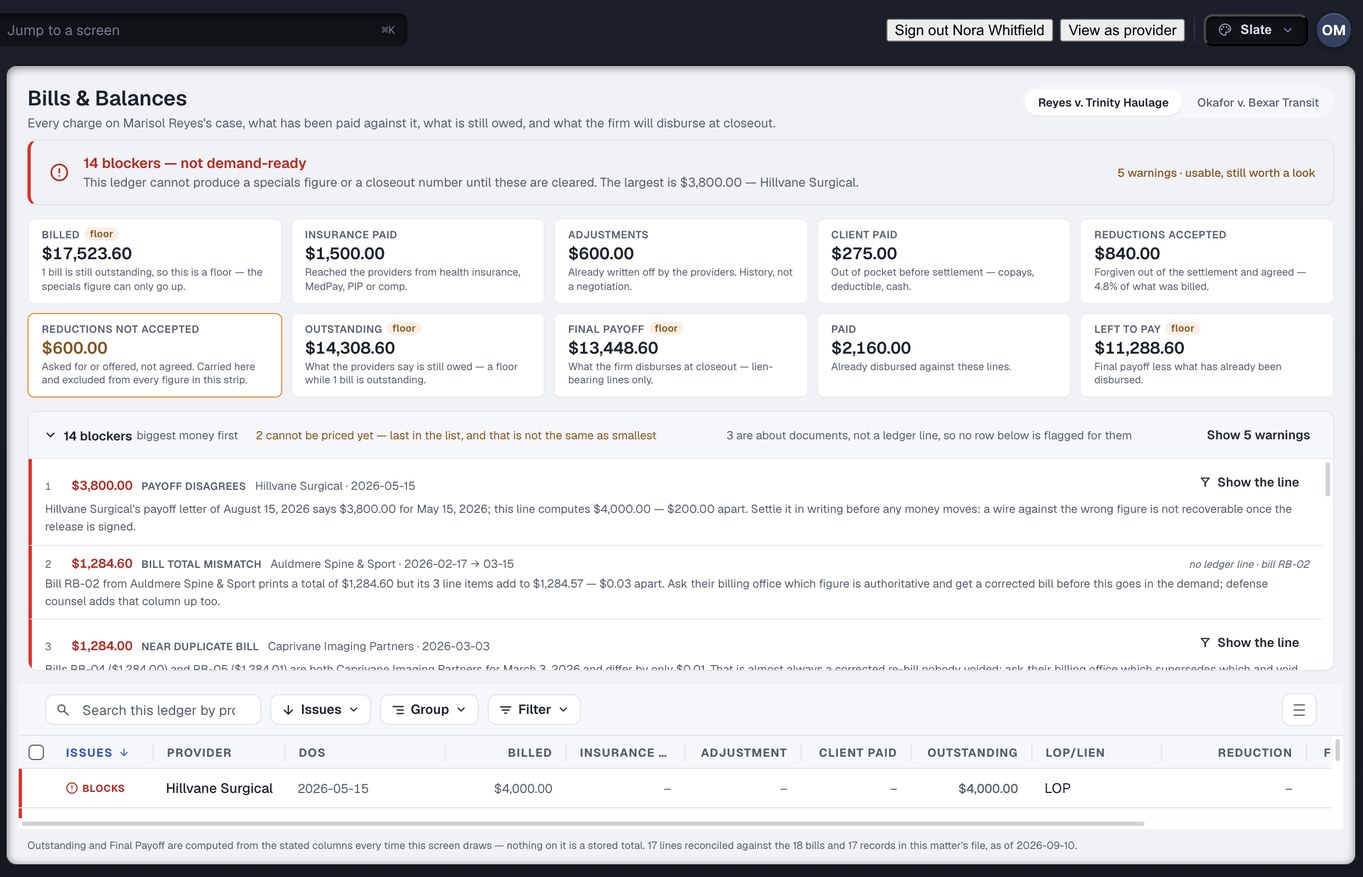
Bills & Balances, captured from the running build, 24 September 2026. Demonstration data — every name, matter and figure is a fixture, not a real client, clinic or balance.
Bills & Balances
Every charge on the matter, what has been paid against it, what is still owed, and what the firm will disburse at closeout. The totals along the top are recomputed from the stated columns every time the screen draws. The word “floor” beside a total means a bill is still missing and the number can only go up. The blockers below are ranked by money, and each says what to settle in writing before any money moves.
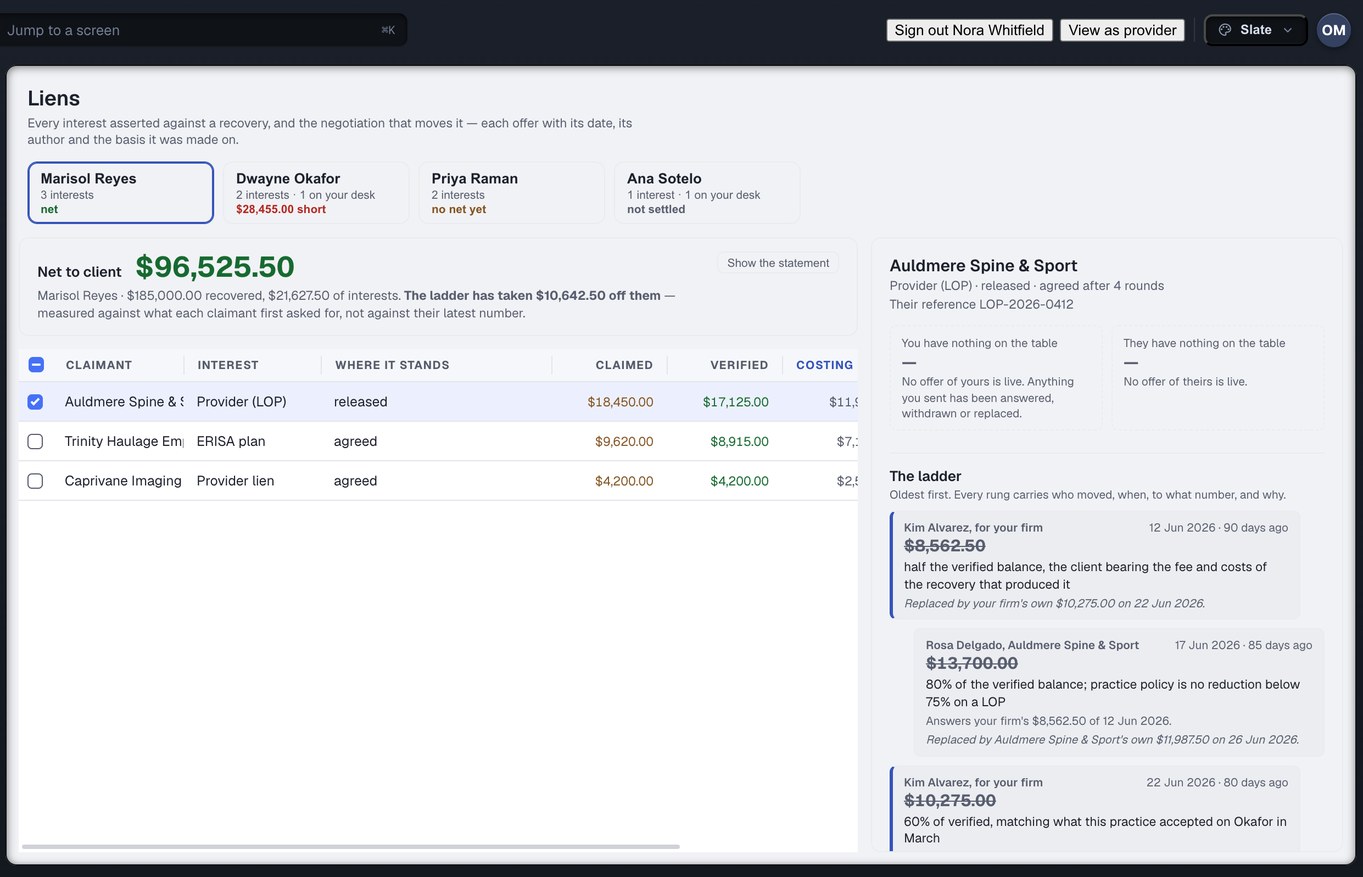
Liens, captured from the running build, 24 September 2026. Demonstration data — every name, matter and figure is a fixture, not a real client, clinic or balance.
Liens and the reduction ladder
Every interest asserted against the recovery, what was claimed against what was checked, and the net to the client with the statement one click away. On the right, the ladder for one provider: oldest rung first, each with who moved, when, to what number and why — and which later rung replaced it. The clinic’s LOPs & Liens screen draws the same ladder from the same events.
The identity, run on this page in whole cents
The figures on the left are the totals in the Bills & Balances capture above, as integers of cents. The outstanding figure on the right is computed by this page’s own script, the way the product computes it: billed, less insurance paid, less adjustment, less client paid, less accepted reductions only. It matches the capture to the cent because there is nothing to round.
For comparison, a decimal machine adding one tenth to two tenths gets {{ floatDrift }}. That is the arithmetic the product refuses to do with money.
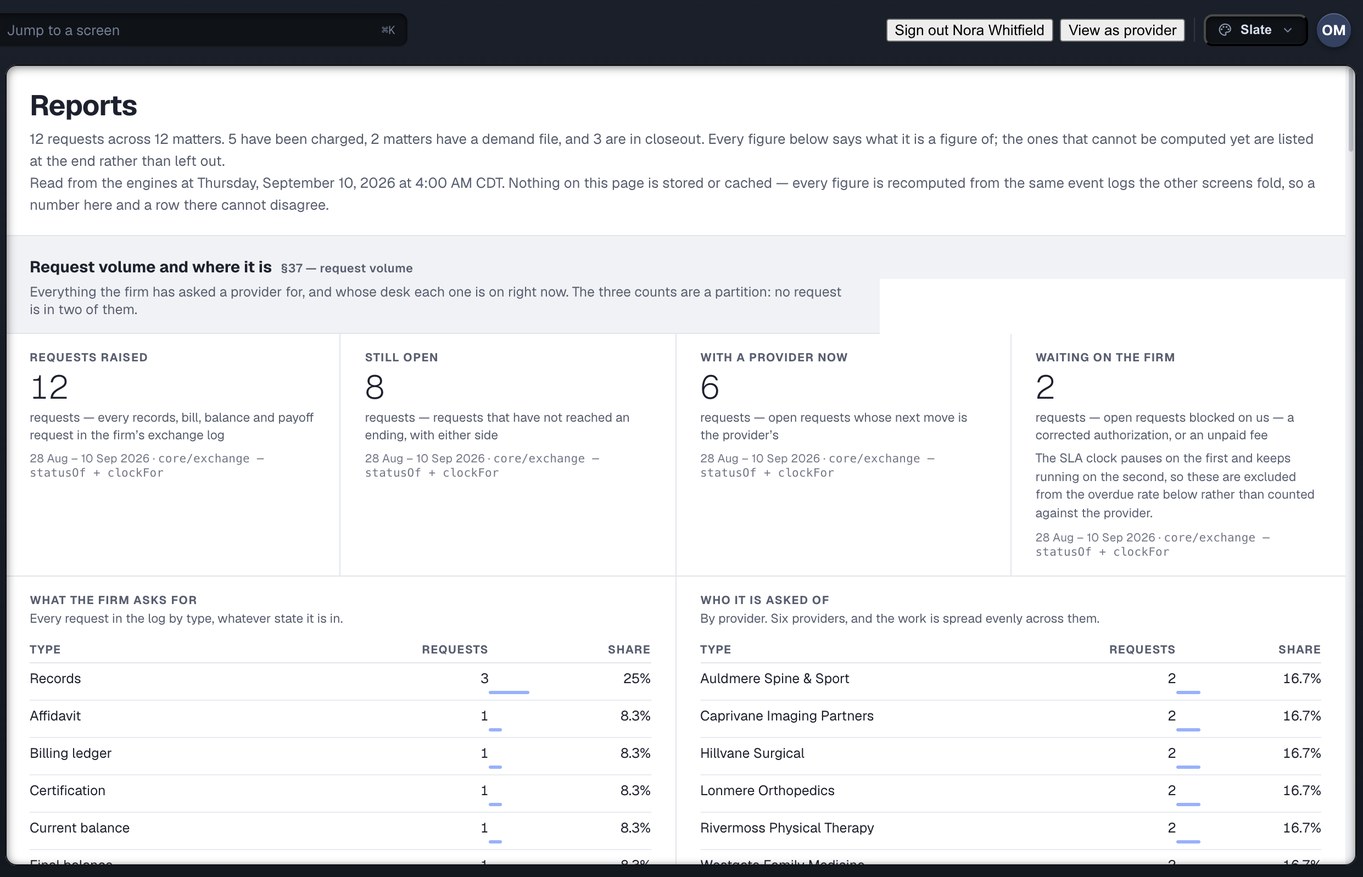
Reports, captured from the running build, 24 September 2026. Demonstration data — every name, matter and figure is a fixture, not a real client, clinic or balance.
Reports
Spend, fulfilment time, overdue rate and provider performance, read from the same event logs the other screens fold. Nothing on the page is stored or cached, so a number here and a row there cannot disagree. Every figure says what it is a figure of and the window it covers, and the ones that cannot be computed yet are listed at the end rather than left out.
Nothing is paid through Injury Docs
It records. It does not transfer. The agreed amount, the approval, the firm’s money arriving, the instruction, the payment and its reference, the provider’s confirmation, the release and the close are each a fact somebody recorded — and the status of a settlement is computed from those facts, never typed into a column.
The wire itself happens at your bank, out of your trust account, under your controls. What Injury Docs adds is the order of operations, the refusal when the order is wrong, and a record of what everybody believed to be true at the time — which is the only question that matters when a provider’s bank says one thing and a screen says another.
Create your firm accountFour things this deliberately is not
Being clear about the edges is how you can trust the middle.
Not a way to move money
No transfer leaves your trust account through Injury Docs. It records instructions, payments by reference, confirmations and releases, in the order they are allowed to happen, and refuses them in any other order.
Not your trust accounting
Your trust ledger, your reconciliations to the bank and your bar-rule obligations live where they live today. What this product holds is the medical side of the disbursement: what each provider is owed, on what basis, and whether it may be paid yet.
Not the negotiator
People make the offers and state the basis. The ladder records who moved, when, to what number and why, computes where things stand, and refuses an acceptance of an offer that has since been replaced. No statute is modelled — what may be reduced, by whom and in what order of priority arrives as configuration a named person reviewed on a named date.
Not a second ledger
The closeout re-derives nothing. The ledger owns what is outstanding; the lien module owns the negotiation and the net to client; the request engine owns each ask. Closeout answers one question — can the firm disburse yet, and if not why — by reading those three.
The six that come up first
What happens when a payoff letter expires before we wire?
The item goes back to needing an ask, and the blocker says so: re-request the payoff, the one on file expired so many days ago, and interest and late charges accrue after a letter is cut. Better, the closeout compares every good-through date with the planned disbursement date and tells you a week ahead which figures will be dead by then, so the replacement is requested before it is late.
Can we record the release once the wire has gone out?
Not until the provider has confirmed the money reached them. Sending is not the same fact as arriving. A release recorded against an unconfirmed payment is a file the firm believes is closed and a lienholder believes is unpaid, which surfaces as a collection letter to the client months after the file was archived. The refusal says what is missing — the confirmation — rather than what failed.
What if the firm sent more than the agreed figure?
It is refused at the point of recording, with the agreed figure, what has already been received and how much the surplus would be. If the settlement itself is larger, the agreed figure has to be raised first. If the extra is fees or costs, it does not belong on this rail at all. The same check runs again when a payment is recorded, so a surplus that arrived before the guard existed still cannot be sent as settlement money.
Who can press pay?
The accounting role and the firm’s owner. The settlement role holds every other verb on the rail — agree, approve, record the money arriving, cancel — and is refused the two that send money, in a sentence that says their desk does not hold that rung. A role that has no Settlements module at all is refused a step earlier, with a different sentence.
Does the clinic see the basis we stated for a reduction?
Yes, word for word, on the same ladder. That is deliberate. A number with a reason can be answered by a billing manager who was not on the call; a number without one gets a counter that argues with nothing. Their offers carry their basis the same way, and both survive into the closing statement’s lien line.
Is any money moved through Injury Docs?
No. There is no processor, no bank connection and no ACH file. The transfer happens at your bank and reaches the record as a reference on an event somebody recorded. What the product enforces is the order — agreed, approved, received, instructed, paid, confirmed, released, closed — and what it keeps is a record of what was believed at each step.
Bring the file that has been waiting on one provider since June.
Create your firm account, open the closeout on one settled matter, and read the blockers list — which provider, how much is behind them, whose move it is, and what the call is.
The ledger in detail: Bills, balances & payoffs → · The ladder: Liens & reductions → · A clinic? Read the provider side →