You see what an order costs before you place it.
This is a page about how pricing works, not a rate card — we have not published one yet, and we would rather say so than put a number here we would have to take back. What follows is how the pricing engine actually behaves: per request, set per provider, shown before you commit, and nothing charged for a request that could not be fulfilled.
Priced per request, and set per provider
A records order is not a subscription tier, so it is not priced like one. The unit is the request — the same object the whole product is built around — and what it costs depends on which clinic you are asking. A hospital system, a chiropractic practice and an imaging centre do not charge alike, and a pricing model that pretends they do is just an average with someone’s margin hidden in it.
One request, one price
You are charged for the ask you actually placed, against the clinic you actually placed it with. Not for seats that sat unused, and not for matters that never needed a chart.
Each provider has its own terms
Price is held against the provider, so the figure you are shown is that clinic’s figure rather than a blended rate. When a clinic’s terms change, what changes is one record — and every request raised after it reads the new one.
Exact to the cent
The pricing engine is one of the thirty-four domain engines under the product, and it obeys the same rule they all do: nothing is rounded, anywhere, on any screen or in any report. What you are quoted is what lands on the ledger.
Injury Docs is not a lender to injured people and never handles a client’s money. The only thing priced here is the work of getting records, bills and figures out of a clinic and onto a ledger both sides can read.
The cost is shown while you can still change your mind
The ordinary way to find out what a records order cost is an invoice three weeks later. Here the figure sits on the request before it sends, alongside the two other things you wanted to know first: how long that clinic actually takes, and whether an order placed against it will arrive at all.
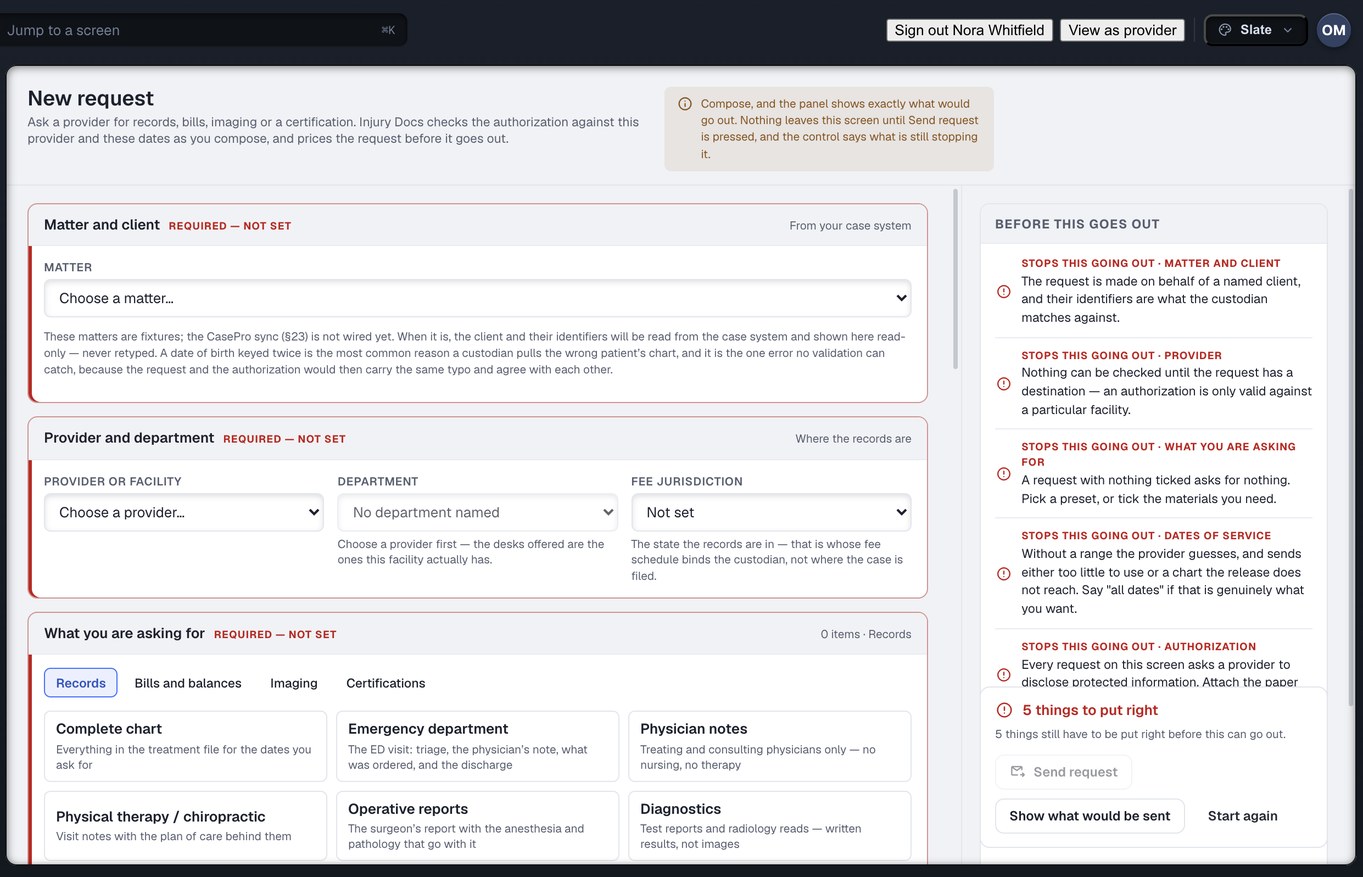
Captured from the running build, 24 September 2026. Demonstration data — every name, matter and figure is a fixture, not a real client, clinic or balance.
A request that cannot be fulfilled is not a charge
Six of the twenty-one request states are endings, and five of those are honest endings rather than success. When a request reaches one of them, there is nothing to bill for — you did not get records. This is the easiest promise on the page to keep, because the states are derived from the log rather than typed by anybody, so there is no version of the story in which a request that failed is recorded as having succeeded.
Nothing is marked complete to make a queue look tidy, and nothing that ended in one of these states is invoiced as though it had been answered.
A duplicate is the one worth dwelling on. In a bulk order it is caught as a blocker before you commit — so the ordinary outcome is not that you are charged twice and refunded once, but that the second request is never raised.
We have not published a rate card, and we will not invent one
You have read a pricing page with no figures on it. That is deliberate. The pricing engine is built and it is exact, but the published rates are not settled, and a number printed here today would be a number we had to walk back. So there is none — not a starting-from, not an illustrative one, not one in small type.
Get the numbers for your firm
What your firm would pay depends on the clinics you actually order from and the volume you actually raise — which is knowable, and which we would rather work out with you than average away. Tell us the providers you are waiting on most and we will come back with the figures for those.
When rate cards are published, they will be published here.
That last one is not a joke. Every firm has it, and it is usually the fastest way to show you what this changes.
Two further things we are not going to claim on a pricing page. We have not earned a compliance badge or a security certification and will not imply one. And Injury Docs has no customer outcomes to quote — no time saved, no return on spend, no settlement figures — because it is new. When there are real ones, they will be real.
Ask us what it would cost for your firm
Bring the clinics you are waiting on and the volume you actually raise. We will come back with figures for those, exact to the cent, rather than a tier you have to translate.
Want to see what you would be paying for? Read how it works →